



What to know
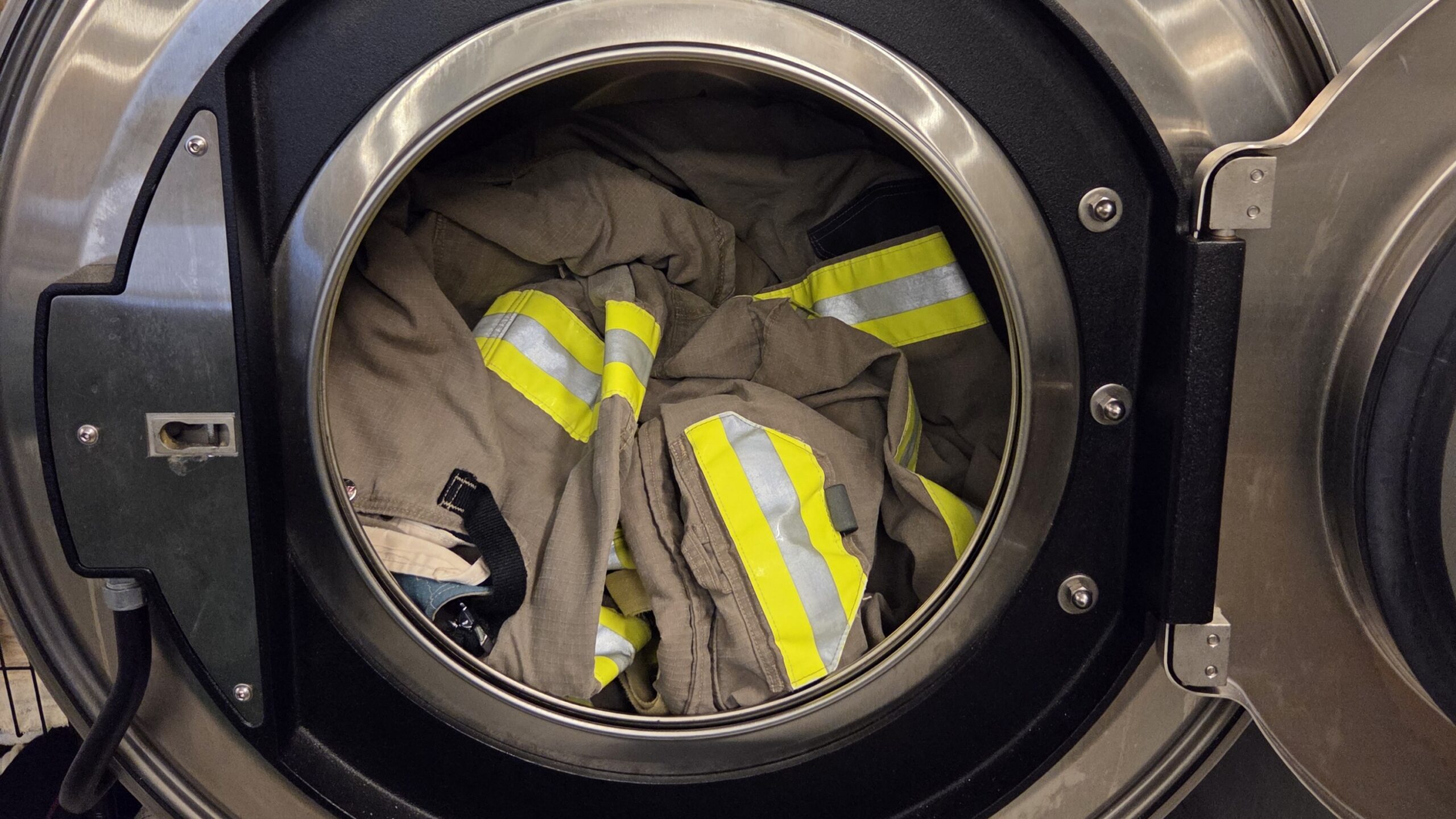
- Firefighters' turnout gear can become contaminated during fire incidents.
- Repeated exposure to contaminated gear may lead to negative health outcomes such as cancer.
- NIOSH evaluates methods for cleaning contaminated gear to reduce firefighters' exposures.
Summary
Contaminated gear can pose health risks to firefighters as exposure to some fireground contaminants has been linked to negative health outcomes including cancer.1 These contaminants can become trapped on or in gear and transfer to firefighters' skin or release vapors (off-gas) into the air, increasing firefighters' exposures.
Through research and partnership, NIOSH evaluates and recommends changes to gear laundering methods to better protect firefighters from these harmful exposures.
Ensuring effective cleaning methods
In 2015, NIOSH partnered with the National Fire Protection Association's (NFPA) Fire Protection Research Foundation, International Personnel Protection, Inc., and Gear Cleaning Solutions, LLC to answer the question, "How Clean is Clean" when it comes to gear.A
At the start of this project, NFPA's standard, 1851, provided requirements for the care and maintenance of firefighter personal protective equipment (PPE), including general cleaning procedures. However, the effectiveness of the cleaning procedures was unclear as they had not been validated. To address this issue, NIOSH
- Developed repeatable laboratory procedures to determine the effectiveness of advanced cleaning methods.
- Used the laboratory procedures to develop a portable PPE Cleaning Validation Kit.
- Used the PPE Cleaning Validation Kit to verify if a cleaning method meets NFPA 1851 standards.
In creating the laboratory procedures, NIOSH analyzed how much contamination remained on the gear after cleaning it. The data revealed that not all contaminants – such as polycyclic aromatic hydrocarbons (PAHs), which have been found on all layers of the turnout ensemble – wash out with typical cleaning methods, raising concerns about long-term health effects of exposure. This finding heightened awareness of contamination and cross-contamination, expanding exposure concerns beyond the fire scene to the apparatus, fire station, and firefighters' homes.
As a result of this research, NFPA
- Revised NFPA 1851 to incorporate laboratory procedures for applying contaminants of interest to gear, extracting the contaminants, and analyzing the gear to validate the level of cleaning.
- Required independent service providers (ISPs) and manufacturers to verify their cleaning methods using the PPE Cleaning Validation Kit. This requirement led to over 80 ISPs receiving certification.
- Revised standards related to station and apparatus design to reduce cross-contamination upon leaving the scene.
By confirming ISPs meet NFPA 1851 cleaning standards and improving station and apparatus design to limit the spread of contaminants, firefighters are better protected on the job. The first stage of this project sparked new studies on how to clean gear more effectively and prevent cross-contamination—both at the fire scene and back at the station.
Exploring changes to cleaning methods
Expanding on the evaluation of cleaning procedures in NFPA 1851, NIOSH dug deeper into how different temperatures and cleaning chemicals impact the cleanliness of gear.
NFPA only allows ISPs and departments to wash gear at a maximum of 105◦F, but NIOSH found that stubborn contaminants like PAHs don't wash out well at that temperature.1 NIOSH conducted a laundering study to see if pre-soaking and washing gear at higher temperatures improved its cleanliness. The results showed:
- Higher temperatures reduced the concentrations of several semi-volatile organic compounds remaining on gear.
- Higher temperatures coupled with a pre-soak further reduced PAH concentrations on gear.
Currently, NFPA does not allow washing at higher temperatures or certain cleaning chemicals due to risks of degrading gear materials. However, these results provide a foundation for discussion and further research on the impact of these cleaning methods.
Current NIOSH efforts
NIOSH continues to explore effective cleaning methods and gain a better understanding of the contaminant exposures firefighters face at different fire incidents. NIOSH is completing the last stage of the "How Clean is Clean?" project, which will
- Validate cleaning methods for other types of firefighter PPE (e.g., helmets, boots).
- Identify effective cleaning methods for each part of the ensemble.
- Identify connections between contaminants and fire types.
NFPA's Fire Protection Research Foundation will share the upcoming results on its PPE and Fire Service Gear Cleaning Validation web page.
Additionally, NIOSH continues to investigate other methods for reducing cross-contamination from gear on and off the fire scene, including the use of exposure controls.
To learn more about NIOSH's work in this area, check out Protecting Firefighters from Contaminated Gear.
To stay up to date on NIOSH's PPE research, subscribe to our new email list.
Author Information
Meghan Kiederer, BA, is a Health Communication Specialist in the NIOSH National Personal Protective Technology Laboratory.
Crystal Forester, MS, is a Research Chemist in the NIOSH National Personal Protective Technology Laboratory.
Jay L Tarley, CFEI, is a Physical Scientist and Lead for the Post-Market PPE Testing Team in the NIOSH National Personal Protective Technology Laboratory.
This bulletin is part of a series produced by the NIOSH Center for Firefighter Safety, Health, and Well-being.
- This research was made possible in part by the U.S. Department of Homeland Security Federal Emergency Management Agency Assistance to Firefighters Grants (EMW-2014-FP-00403, EMW-2017-FP-00582, and EMW-2020-FP-00865), the CDC Foundation, and the following project partners: Fire Protection Research Foundation; International Personnel Protection, Inc.; and Gear Cleaning Solutions, LLC.
- Forester C, Tarley J (2023). Effects of Temperature and Advanced Cleaning Practices on the Removal of Select Organic Chemicals from Structural Firefighter Gear. Fire Technology, 59. 2127-2145. http://dx.doi.org/10.1007/s10694-023-01421-8