


What to know
- Hazardous substances can transfer from firefighters' gear to their skin, equipment, and station.
- These contaminants have been linked to cancer and other illnesses.
- Cleaning and properly removing, bagging, and storing gear can help limit exposure.
Summary
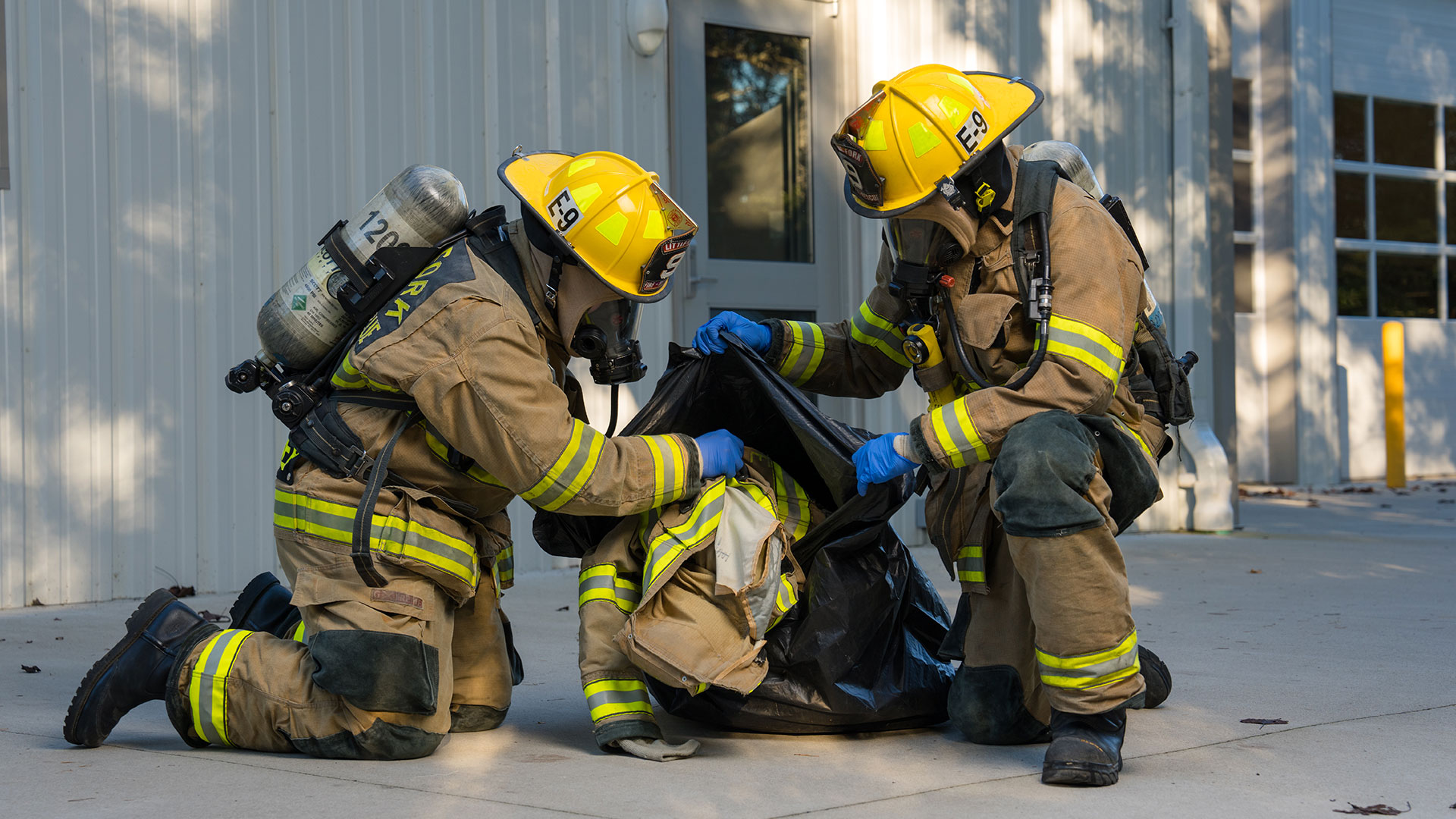
Firefighters can be exposed to hundreds of different chemicals at fire incidents. Some of these hazardous chemicals are produced when things burn, such as benzene, formaldehyde, and polycyclic aromatic hydrocarbons (PAHs). Others may be released when building materials fall apart, like asbestos in older buildings. These hazardous substances can contaminate firefighters' protective clothing, known as turnout gear. On and off the scene, these contaminants can transfer from firefighters' gear to their skin, other equipment, or areas within the station. These contaminants then may unknowingly be inhaled, ingested, or absorbed.
Reducing exposure to these contaminants is important, as some have been linked to negative health outcomes for firefighters including cancer.1 Through research and partnerships, NIOSH evaluates effective exposure controls to better protect firefighters from contaminated gear.
Limiting the spread of contaminants
Laundering gear is important to reduce firefighters' exposure to contaminants and limit cross-contamination (see Laundering Gear to Protect Firefighters), but it's not the only way. When looking at how to reduce exposures, it's crucial to know how they happen. Contaminants primarily enter firefighters' bodies by being (1) breathed in, (2) ingested, or (3) absorbed through the skin.
NIOSH focuses on research to understand these exposure pathways and evaluate protective measures to control or limit them. To do this work, NIOSH teamed up with the University of Illinois Fire Service Institute and the Fire Safety Research Institute, part of UL (Underwriters Laboratories) Research Institutes.
NIOSH research and other studies show that the following actions can help reduce exposures on the scene, within the fire apparatus and station, and even in personal residences and vehicles:
- Cleaning gear and skin on the scene
- Properly removing gear
- Bagging gear
Cleaning gear and skin on the scene
Contaminants on gear can transfer to firefighters' skin where they could be absorbed or ingested.
Practicing gross decontamination (also known as preliminary exposure reduction) before removing gear can help prevent this exposure. Gross decontamination involves washing hazardous materials off gear and equipment at the scene. NFPA 1010 requires firefighters to be able to perform field reduction of contaminants to lessen their exposures.2
Best practice involves using detergent or soap with a scrub brush to decontaminate gear before removing it. Using detergent or soap has proved more effective than water alone at removing soot and contaminants such as PAHs.13
After removing gear:
- Use skin cleansing wipes (or soap and water) to remove contaminants before they are absorbed.
- Wash hands well before eating to reduce the chance of accidentally ingesting contaminants.
Properly removing gear
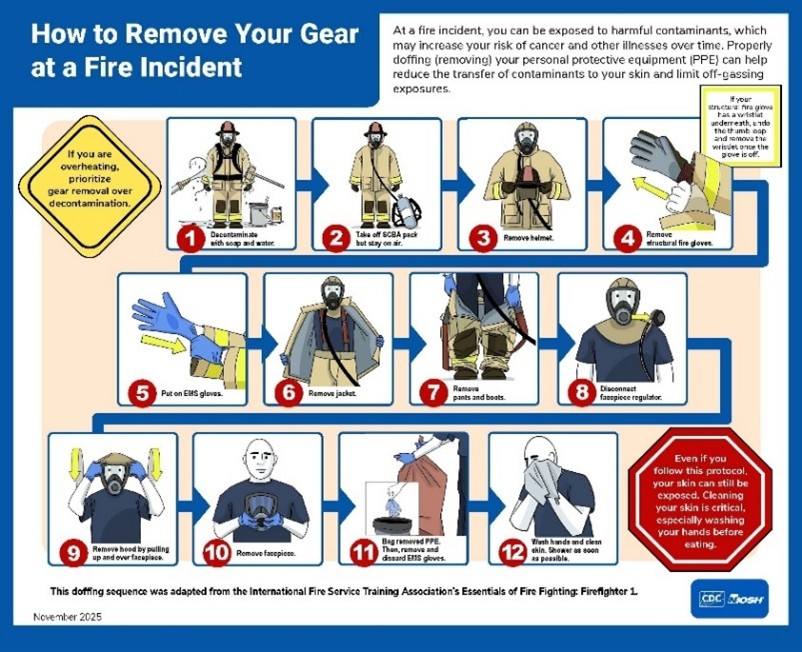
Doffing (removing) gear can also pose an exposure risk. Certain traditional doffing methods may result in bare skin touching contaminated gear, potentially increasing exposure.For3 example, pulling the hood down around the neck after firefighting can result in contaminants on the outside of the hood transferring to the neck.
The infographic below shows how to doff gear, including how to use an overhead hood removal technique to limit exposure.4 NIOSH developed the infographic using existing research and the process described in NFPA 1010.
Bagging gear
Some contaminants at a fire scene may release vapors into the air, known as off-gassing. This off-gassing can create an inhalation risk.3
After removing gear:
- Bag gear to prevent breathing in any contaminants that are off-gassing.
- Place gear in a non-passenger compartment of the fire engine or vehicle (called fire apparatus) for transport.
- Do not put gear in personal vehicles or bring it home.
Storing gear
At the station, store gear in a dedicated gear-storage area to help isolate contaminants. This area also protects gear from other sources of contamination like diesel engines in the apparatus bay (where fire apparatuses, such as fire engines, are housed).
Additional actions that can help further limit the spread of contaminants include:
- Prioritize laundering of exposed gear.
- Use exhaust fans in the gear storage area that discharge outdoors.
- Keep gear out of living and office areas like recreation rooms and bedrooms.
Protecting current and future firefighters
Practicing effective decontamination procedures and properly removing, bagging, and storing gear can help departments and firefighters protect against exposures that could be hazardous to their health.
National Firefighter Registry (NFR) for Cancer
Additionally, the NIOSH National Firefighter Registry (NFR) for Cancer is working to enhance our understanding of cancer risk in the fire service. With strong support from the fire service, the NFR is now the largest group of U.S. firefighters ever assembled to study cancer in the fire service, and it continues to grow. All U.S. firefighters—paid or volunteer, active or retired, and any specialty—can join this historic effort to understand and reduce cancer. To learn more about the NFR and how to join, visit the NFR's web page.
Author Information
Kenny Fent, PhD, CIH, is an Industrial Hygienist and Lead of the National Firefighter Registry for Cancer in the NIOSH Division of Field Studies and Engineering.
Andrea Wilkinson, MS, LAT, ATC is a Research Health Scientist in the NIOSH Division of Field Studies and Engineering.
Wesley R. Attwood, DrCJ, is the Senior Investigator with the NIOSH Fire Fighter Fatality Investigation and Prevention Program in the NIOSH Division of Safety Research.
Meghan Kiederer, BA, is a Health Communication Specialist in the NIOSH National Personal Protective Technology Laboratory.
Jennifer Tyrawski, PhD, is a Health Communication Specialist in the NIOSH Division of Field Studies and Engineering.
This bulletin is part of a series produced by the NIOSH Center for Firefighter Safety, Health, and Well-being.
This page was last updated on this date. Updates may include minor edits, image changes, or other modifications to page content.
The information on this page was last reviewed by subject matter experts to ensure accuracy.
- Horn GP, Fent KW, Kerber S, Smith DL. (2022). Hierarchy of contamination control in the fire service: Review of exposure control options to reduce cancer risk. Journal of Occupational and Environmental Hygiene, 19(9), 538–557. https://doi.org/10.1080/15459624.2022.2100406
- NFPA (2024). NFPA 1010, Standard on professional qualifications for firefighters. Quincy, MA: National Fire Protection Association. https://www.nfpa.org/codes-and-standards/nfpa-1010-standard-development/1010
- Fent KW, Alexander B, Roberts J, Robertson S, Toennis C, Sammons D, Bertke S, Kerber S, Smith D, Horn G (2017). Contamination of firefighter personal protective equipment and skin and the effectiveness of decontamination procedures. J Occup Environ Hyg, 14(10), 801-814. https://doi.org/10.1080/15459624.2017.1334904
- IFSTA (2024). Essentials of fire fighting: Firefighter 1. 8th ed. Stillwater, OK: International Fire Service Training Association.