



Key points
- Meningococcal disease occurs worldwide.
- The highest incidence of meningococcal disease is found in the 'meningitis belt' of sub-Saharan Africa.
- Other regions of the world experience lower overall rates of disease and occasional outbreaks.
- Learn about global trends in meningococcal disease.
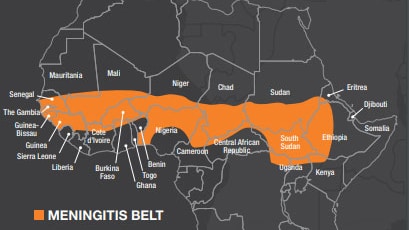
Meningitis belt
The meningitis belt of sub-Saharan African historically experienced major epidemics of meningococcal disease every 5 to 12 years. Attack rates during these epidemics reached up to 1,000 cases per 100,000 population.
Risk factors for meningococcal disease outbreaks in Africa aren't fully understood. However, the following characteristics create favorable conditions for meningococcal disease epidemics:
- Dry, dusty conditions during the dry season (December to June)
- Immunological susceptibility of the population
- Travel and large population displacements
- Crowded living conditions
Vaccine impact
Historically, outbreaks in the meningitis belt were primarily due to serogroup A meningococcal disease. With the introduction of a monovalent serogroup A meningococcal conjugate vaccine (MenAfriVac®) in the region starting in 2010, recent meningococcal outbreaks are now primarily caused by serogroups C and W; serogroup X outbreaks have also been reported.
A new vaccine (called Men5CV) has more recently been developed to help protect against five serogroups (A, C, W, Y, and X). This vaccine was first used in 2024 in Nigeria and Niger in response to outbreaks in those countries.
CDC's role
With the goal of eliminating epidemics of meningitis in sub-Saharan Africa, CDC works with African ministries of health and other partners to
- Strengthen meningitis surveillance
- Evaluate the impact of Men5CV
Outside of Africa
In Europe, the Americas, and Australia, serogroups B, C, W, and Y together account for a large majority of cases.
In temperate regions, the number of cases increases in winter and spring.
The annual Hajj and Umrah pilgrimages to Saudi Arabia also have also been associated with outbreaks of meningococcal disease among returning pilgrims and their contacts. This includes six cases in Umrah participants and their contacts in the United States in 2024.