
How CFA Sets Confidence Levels

What to know

  • CFA uses confidence levels to assess certainty in our work based on the extent and quality of information available and how well different lines of evidence corroborate one another.
  • Confidence levels are defined in three levels: low, moderate, and high.

What are confidence levels?

CFA uses confidence levels as a way to assess certainty in our work based on the extent and quality of information available and how well different lines of evidence corroborate one another. These confidence levels incorporate the entire body of evidence in our risk assessments and scenario assessments and are different from how we assign uncertainty in our expert elicitation process, which only takes into account individual uncertainty when assessing expert judgment.
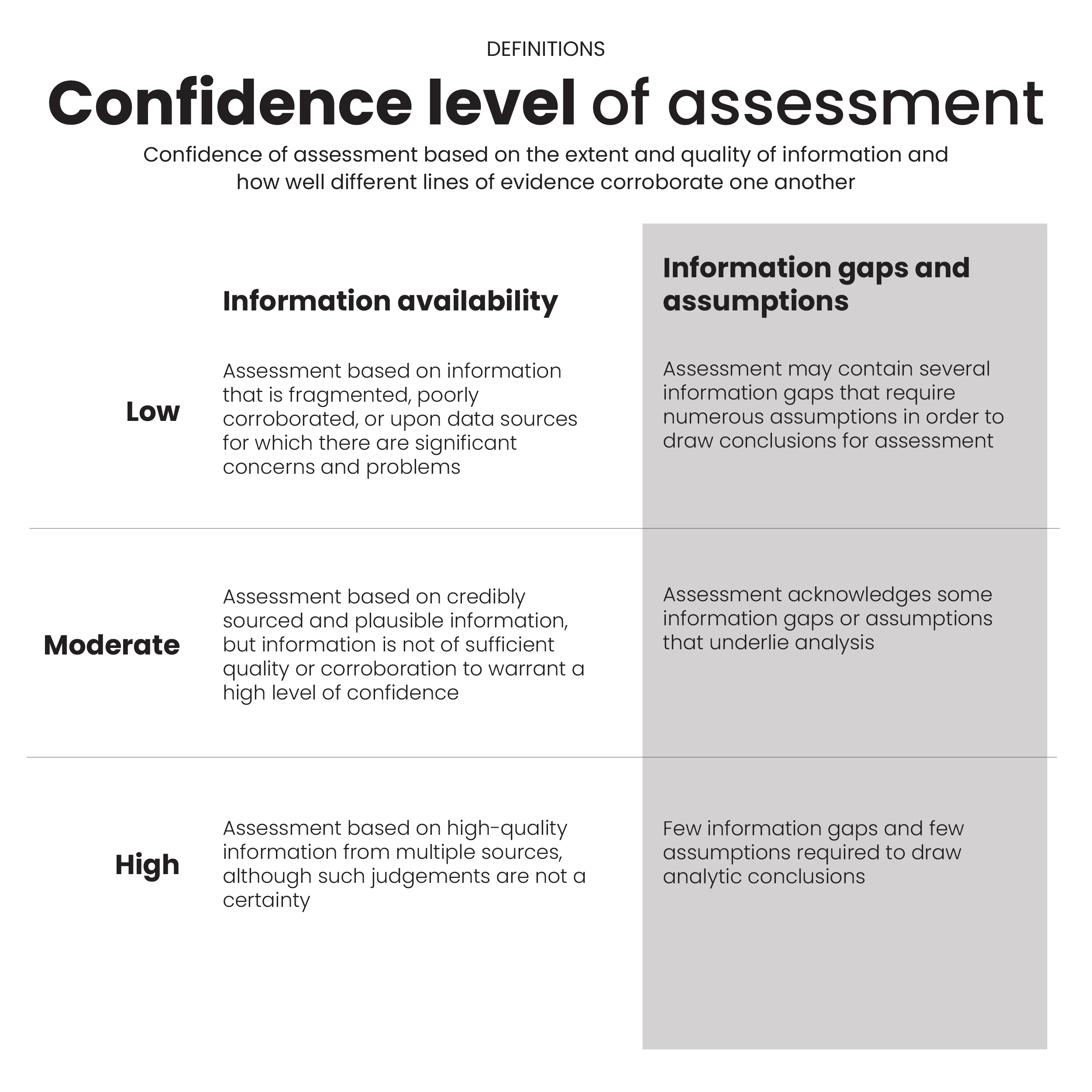
Assessment table

Table of definitions used for each level of confidence.
The confidence level of an assessment depends on information availability and any information gaps or assumptions.

Confidence level of assessment.

Confidence of assessment based on the extent and quality of information and how well different lines of evidence corroborate one another.

  • Low confidence: Assessment is based on information that is fragmented, poorly corroborated, or upon data sources for which there are significant concerns or problems. There may be several information gaps that require numerous assumptions in order to draw conclusions for the assessment.
  • Moderate confidence: Assessment is based on credibly sourced and plausible information, but the information is not of sufficient quality or corroboration to warrant a high level of confidence. The assessment acknowledges some information gaps or assumptions that underlie analysis.
  • High confidence: Assessment is based on high-quality information from multiple sources, although such judgments are not a certainty. There are few information gaps, and few assumptions are required to draw analytic conclusions.