



At a glance
eNews is the monthly newsletter of the National Institute for Occupational Safety and Health (NIOSH). Each month includes an update from NIOSH Director Dr. John Howard, featured NIOSH research, new worker safety and health resources, upcoming meetings, and more!
From the Director's Desk
John Howard, M.D., Director, NIOSH
3D Printing: Protecting Workers Turning Plastic Waste into Filament
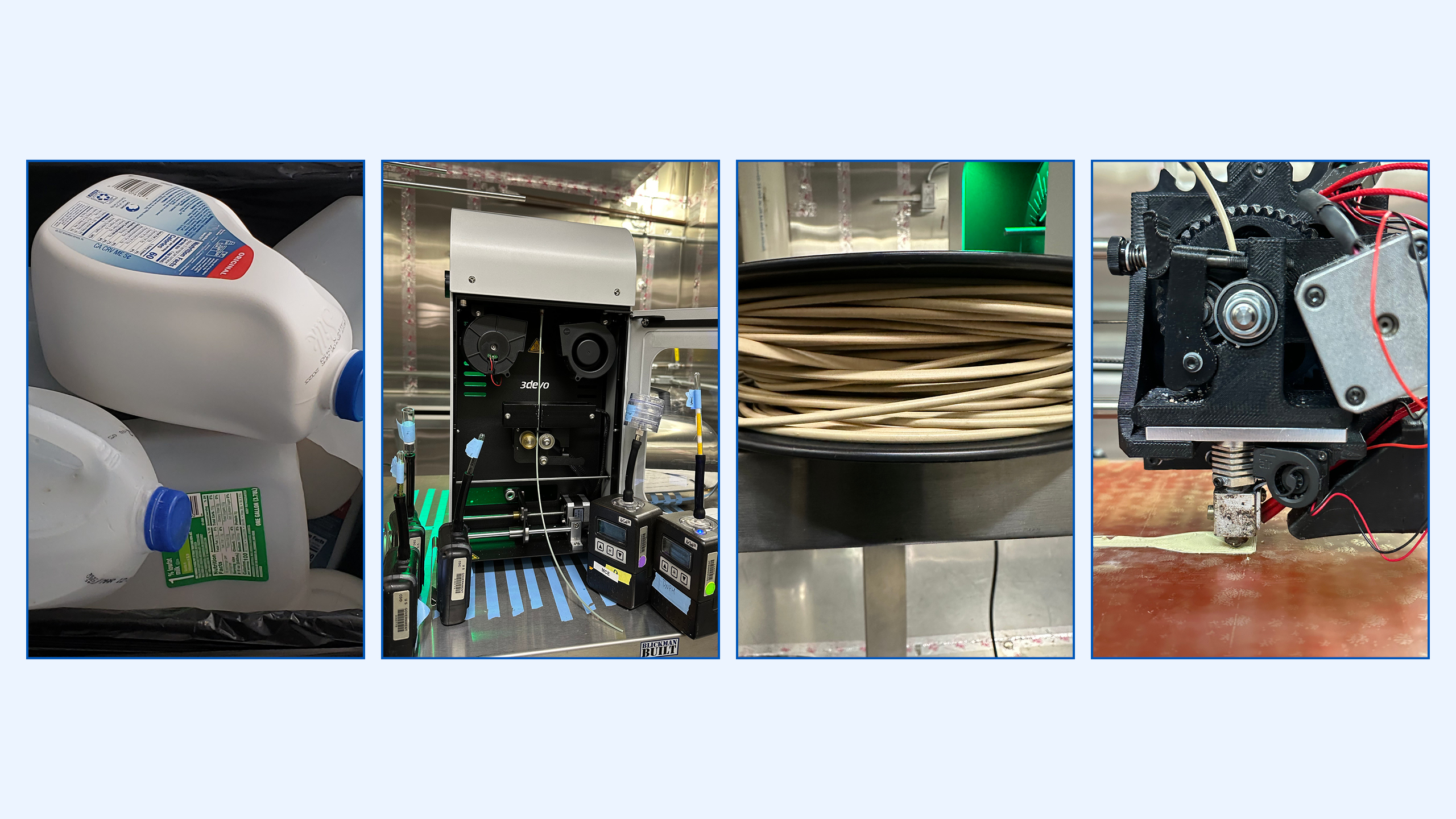
NIOSH researchers are tackling the global problem of plastic waste. They are studying good workplace practices for workers to safely recycle plastics so these materials can be used for three-dimensional (3-D) printing products.
Plastics are all around us. In 2020, enough plastic was made to circle the earth 1500 times.1 Demand for plastics is predicted to continue increasing, reaching approximately 1 billion tons worldwide by 20502. Most plastics are designed for single use, meaning they are used once and then either disposed of or sometimes recycled3.
However, it is possible to reuse plastic waste by turning it into filaments for 3-D printing of commercial products. Filament is the material fed into a 3-D printer to make objects. It looks like thick fishing line. Making filament from recycled plastics can be economically attractive for 3-D printing businesses. This recycling approach can result in energy and cost savings for businesses when compared with buying new, commercially made filament.
Recycling plastic waste involves several steps. These include sorting the plastics, shredding them into small pieces, and then melting the pieces. Research has shown that melting plastics to make filament causes the plastic molecules to break down. However, it is not known how this breakdown affects plastic properties. Little is known about what is released into the air when making filament or when using it for 3-D printing. Therefore, NIOSH has identified the importance of learning more about potential exposures and health effects, especially among workers who are repeatedly exposed.
In partnership with external researchers, NIOSH is evaluating emissions from high density polyethylene (HDPE). HDPE is a common type of plastic used for food containers, including milk jugs, and for personal-care products, such as shampoo bottles. For this study, plastic waste from HDPE is made into filament and then used for 3-D printing. During this process, researchers measure the chemicals and particles released into the air. After making the filament and printing a 3-D object, the plastic is analyzed to see how it changed. The process is then repeated.
Preliminary results show that HDPE can be recyclable into useable 3-D printing filament seven times. Results also indicate that the number of potentially toxic particles released when making filament decreases the more times it is recycled. This could mean an added value for recycling plastics through a lower health risk for workers from exposures.
The equipment to make filament from recycled plastics and the cost of 3-D printers continue to decrease. All the while, plastic waste continues to grow around the world. Ongoing NIOSH research can help us better understand ways to recycle plastics for commercial use and reduce plastic waste. This research can also ensure turning plastic waste into 3-D printing filament is safe for workers, cost-effective, and energy-efficient.
For more information, go to the NIOSH webpage Additive Manufacturing (3D Printing) | Manufacturing | CDC. The page provides many useful safety and health resources for 3-D printing with plastics, including guides, posters, and infographics.
Research Rounds
Trends in Parcel Delivery Driver Injury: Evidence from NEISS-Work
Study authors: Evan Iacobucci, Missouri State University; Suzanne Marsh, NIOSH; Rebecca Naumann, CDC; and Noreen McDonald, University of North Carolina, Chapel Hill
Why is this study important?
With the continued popularity of online shopping, or e-commerce, parcel delivery drivers handle more packages, drive more miles, and serve more customers during their daily routes. To prevent injuries from this increased delivery volume, we need to understand the nature of these injuries.
How did you do the study?
We looked at injuries among two groups: (1) U.S. Postal Service delivery drivers and (2) couriers and messengers. These injuries involved workers aged 18 and older who were treated in U.S. emergency departments during 2015–2022. Using information from the occupational supplement to the National Electronic Injury Surveillance System (NEISS), we described injury characteristics and trends for both worker groups.
What did you find?
During the 7-year study, an estimated 151,000 injuries among U.S. Postal Service delivery drivers and 182,000 injuries among couriers and messengers were treated in emergency departments. We found that rates for injuries among both groups increased as the overall U.S. industry injury rates declined. While injury rates for the two groups went up and down over time, both moved toward a position much higher than average.
More than half (57%) of treated injuries were among female Postal Service delivery drivers, with males accounting for 43%. For couriers and messengers, male parcel delivery drivers sustained most of the treated injuries among couriers and messengers (69%), compared with 31% among female workers.
What are the next steps?
The findings from this study can help inform future research in this area. Knowing where and how these injuries occur may help create better ways to protect workers.
Highlights
NIOSH Announces New Black Lung Screening Dates
The NIOSH Coal Workers' Health Surveillance Program announced it will offer black lung screenings March 17–21 in Summersville, Oak Hill, and Beckley, West Virginia. Participation provides coal miners with a free health exam and a confidential report on their lung health.
NIOSH Seeks Public Input on Firefighter Safety and Health Priorities
NIOSH recently published a Request for Information to gather public input on priority topics related to firefighter safety and health. This feedback will help NIOSH refine its existing research, service, and engagement priorities related to firefighter safety, health, and well-being. The input will also help ensure that NIOSH's work stays responsive to emerging risks, workforce needs, and opportunities to collaborate with the fire service and related organizations. Comments must be received on or before April 3.
NIOSH Partners With AIHA in the Annual Safe-in-Sound Award Program
NIOSH welcomes the American Industrial Hygiene Association (AIHA) as a new Safe-in-Sound Award partner, joining existing partners. The partnership was announced last month at the 50th annual Hearing Conservation Association annual conference. Nominations for the 2027 Safe-in-Sound Award are now open. Learn more or apply on the award website.
National Firefighter Registry for Cancer Is Now the Largest in the Nation
More than 40,000 firefighters have joined the National Firefighter Registry for Cancer. It is now the largest firefighter cohort in the country focused on understanding job-related cancer risk and advancing prevention efforts to protect firefighters' health. Read this CDC press release for more information about this milestone.
NIOSH Scientists Receive Public Health Service Outstanding Unit Citation
Dr. Wesley Attwood, CAPT John Gibbins, and LCDR Sarah Hughes were recently recognized by the U.S. Public Health Service with an Outstanding Unit Citation for their service on the Interagency Correctional Food Safety Workgroup. Working with other federal agencies this group of officers and civilians developed the first Model Food Safety Practices for Correctional Facilities guidance. This guide aims to make over 3,000 U.S. correctional facilities safer from food safety threats.
Federal Register Notices
National Institute for Occupational Safety and Health (NIOSH) Center for Firefighter Safety, Health and Well-Being Portfolio; Request for Information
The notice was posted February 2. Comments must be received by April 3.
Proposed Data Collection Submitted for Public Comment and Recommendations: The National Firefighter Registry for Cancer (NFR)
The notice was posted February 24. Comments must be received by April 27.
New Communication Products
NIOSH Science Bulletin
Formerly called the NIOSH Science Blog
News From Our Partners
Join OSHA for Workers Memorial Safety Summit & Ceremonies
The Occupational Safety and Health Administration (OSHA) will host a Workers Memorial Safety Summit and Workers Memorial Ceremonies on April 20–24 at the U.S. Department of Labor in Washington D.C. This event honors fallen workers and promotes occupational safety and health. Visit the OSHA Workers Memorial webpage for more information.