



At a glance
eNews is the monthly newsletter of the National Institute for Occupational Safety and Health (NIOSH). Each month includes an update from NIOSH Director Dr. John Howard, featured NIOSH research, new worker safety and health resources, upcoming meetings, and more!
From the Director's Desk
John Howard, M.D., Director, NIOSH
The NIOSH Respirator Approval Program: Boosting Efficiency and Battling Counterfeits in the Respirator Marketplace
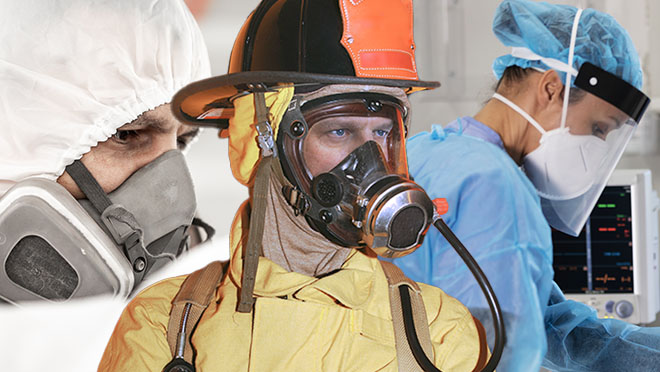
Respiratory protection is an essential part of occupational safety and health programs in many workplaces. The respirators used within these workplaces must be tested and approved by NIOSH to ensure they meet strict performance and quality assurance standards. NIOSH approval is vital to the health and safety of workers who rely on respirators to keep them safe. Without this certification and ongoing quality assurance, workers risk using respirators with insufficient levels of protection, which can result in devastating health consequences.
Over the past year, the NIOSH Respirator Approval Program has continued to strengthen its efficiency and customer service for current and potential respirator approval holders. These improvements are aimed at streamlining the approval process to better meet the needs of NIOSH respirator approval holders and have already produced measurable results.
In 2024, the average application processing time was 100 days. From mid-May 2025 to present, that average has fallen to 65 days, a 35% reduction. These improvements stem from ongoing efforts to streamline processes, cross-train staff, and increase the support provided to applicants throughout the approval pathway. Early, enhanced communication between NIOSH and the applicants helps them prepare strong submissions and successfully navigate the respirator approval process. When additional information is needed, NIOSH has improved its ability to provide more focused, actionable technical assistance to help resolve issues as efficiently as possible. These efforts also resulted in NIOSH granting 528 new respirator approvals in 2025. Among these new approvals are 140 new self-contained breathing apparatus configurations (SCBA)—all equipped with chemical, biological, radiological, and nuclear (CBRN) protections—that will be used to protect firefighters, first responders, and law enforcement.
NIOSH also continues to focus on the integrity of approved products. Through ongoing factory audits, quality-system reviews, and off-the-shelf testing, NIOSH confirms that approved products continue to meet approval requirements while on the market. Counterfeit products on the market, as well as products that misrepresent the NIOSH approval may give consumers a false sense of confidence in the level of protection they are receiving, putting their safety at risk. NIOSH investigated 4,163 potentially fraudulent respirator online listings (misrepresenting or misusing the NIOSH certification marks N95, P100, and NIOSH Approved). NIOSH identified 1,245 fraudulent listings since May 2025. Of these, 260 were reported on everyday, highly visible, online marketplaces, resulting in 189 removals.
Through these activities and ongoing improvements to the NIOSH Respirator Approval Program, workers can be assured that their approved respirators, when used and fitted correctly, are providing the expected level of protection.
For more information about NIOSH efforts combating counterfeit respirators and tips for spotting fraudulent respirator components, see our webpage and fact sheet and the recent PPE Case Report detailing performance testing of fraudulent P100 filters, chemical cartridges, and combination cartridges.
P100 is a registered certification trademark of the U.S. Department of Health and Human Services (HHS) in the United States.
N95 and NIOSH Approved are registered certification trademarks of the U.S. Department of Health and Human Services (HHS) in the United States and several other countries.
Research Rounds
Fatal Work-related Motor Vehicle Crashes in the United States, 2011–2014: Analysis of Matched Data from the Census of Fatal Occupational Injuries and the Fatality Analysis Reporting System
Study authors: Rosa L. Rodríguez-Acosta, NIOSH; Christen G. Byler, Bureau of Labor Statistics; and Stephanie G. Pratt, NIOSH
Why is this study important?
Motor vehicle crashes are the leading cause of work-related deaths in the United States. To prevent these crashes, it is important to understand where and how they occur.
How did you do the study?
Working with partners, we matched roadway deaths captured in the Census of Fatal Occupational Injuries (CFOI) to all fatally injured occupants captured in the Fatality Analysis Reporting System (FARS) for 2011-2014. We then conducted descriptive analyses at the crash, vehicle, and person levels.
What did you find?
Through the match, we identified 3,822 crashes, with most (3,156) resulting from a collision. We also determined that workers who died were driving or riding in 3,879 of vehicles in these crashes. More than half of these vehicles were large trucks. We found that multiple worker deaths occurred in 203 vehicles, usually in heavy trucks, pick-up trucks and vans.
At the person level, we identified 4,060 workers who died in a motor vehicle crash during the study period. Most of these workers (3,581) were drivers. By industry, we observed the highest proportions were in transportation, warehousing, and utilities (39%), and services (24%). Within industries, mining, quarrying, and oil and gas extraction (29%) and construction (20%) had the highest proportions of deaths.
For 20% of the drivers, the investigating officer indicated that speed contributed to the crash. Reports also revealed a small number of drivers were impaired by being asleep or fatigued; under the influence of alcohol, drugs, and medications; or blacked out. Over a third of those who died were not using seat belts, and a small number were riding in vehicle areas meant for cargo.
What are the next steps?
These findings can be used to develop focused interventions to prevent motor vehicle crashes among workers whose jobs involve driving.
Highlights
Help Promote Firefighter Cancer Awareness
January is Firefighter Cancer Awareness Month , an opportunity to recognize the impact of work-related cancer across the fire service. The National Firefighter Registry (NFR) for Cancer has updated its toolkit for 2026, with ready-to-use social media images, web banners, email copy, and a downloadable QR code. Please consider using these materials to encourage firefighters to join the NFR this month.
Evaluating HVAC Systems in Healthcare Facilities Caring for Measles Patients
A new checklist can help public health partners assess HVAC systems in healthcare facilities that are caring for measles patients. Infection preventionists and healthcare facility managers can also use this checklist to consider actions they can take to prepare for a patient with measles.
New Training Videos on Using PPE to Prevent Exposures to H5N1 Bird Flu
A series of new videos is now available to help employers educate workers on how to wear personal protective equipment (PPE) to prevent exposures to H5N1 bird flu. The videos provide step-by-step instructions for how to put on and remove PPE in different workplace settings.
Federal Register Notices
Meeting of the Advisory Board on Radiation and Worker Health, Subcommittee for Procedure Reviews, National Institute for Occupational Safety and Health
The notice was posted on December 29. Comments must be received by January 21. The meeting will be held on January 28.
News From Our Partners
New Study Examines Factors Associated with Underutilization of Workers' Compensation Insurance
A new study from the Washington State Occupational Health Surveillance Program suggests that workers' compensation data are more likely to miss younger workers, workers with poor mental health, and workers in service-related industries and occupations. The study analyzed data from the Behavioral Risk Factor Surveillance System to estimate use of workers' compensation insurance for work-related injuries and illnesses. Overall, 51% of workers with work-related injuries and illnesses utilized workers' compensation, while estimates differed by age, education, industry, occupation, and health status.
OSHA Releases New Injury and Illness Data
The Occupational Safety and Health Administration (OSHA) has released its 2023 Injury and Illness Data using standardized codes. OSHA applied the Occupational Injury and Illness Classification System to the narrative fields in Forms 300 and 301, capturing details about how incidents happened and what caused them. These codes help OSHA organize and analyze similar cases more efficiently, making it easier to identify trends and patterns.
Updated OSHA Data Webpage Improves Access to Public Datasets
The Occupational Safety and Health Administration (OSHA) has updated and redesigned the OSHA Data webpage to improve accessibility and navigation of publicly available datasets. The redesigned page brings all datasets together in one convenient location, organized by topic, and features a layout consistent with other OSHA webpages, providing a clearer, more streamlined user experience.