



What to know
Summary
National Institute for Occupational Safety and Health (NIOSH) engineers developed guards to put a physical barrier between rotating machinery and workers to prevent entanglements. The use of design to eliminate or reduce this hazard is an example of prevention through design or PtD. The result reduced the risk of injury and death for commercial fishermen.
Background
Commercial fishing is a dangerous industry. While most commercial fishing fatalities are related to drownings,1 there are many other hazards workers face in the industry. Between 2000 and 2019, 122 U.S. fishermen were killed while working on deck on fishing vessels. Examples of fatal onboard injuries include being struck by gear or other objects or being entangled in machinery. These types of incidents accounted for 14% of all deaths in commercial fishing during this time period.2
Using the principles of Prevention through Design (PtD) can eliminate or greatly reduce hazards to fishermen.
PtD is the practice of eliminating or reducing hazards to workers through design changes to facilities, work processes, equipment, tools, products, or the organization of work.3 The following example shows how PtD solutions from NIOSH are protecting fishermen.
The problem: entanglement hazards
Commercial fishermen often rely on winches and haulers to help reel in gear like large fishing nets and pots. These machines can be serious entanglement hazards to deckhands. On smaller fishing vessels, the winch is usually mounted in the center of the deck. The winch's drums and capstans (additional shafts that line can be wrapped around for other lifting or pulling tasks) rotate as the crew works around it. Fishermen can become caught in the fishing line as it tightens and winds around the drum or capstan.
Entanglement can happen suddenly, pulling the worker into the machinery with immense force. This can also pull them away from the controls they could use to stop the winch. This can lead to severe injuries like crushed limbs, amputations, and death.
NIOSH investigates
Shrimp fishermen in the Gulf Coast region often work with hazardous deck winches. Unguarded drum winches are a common hazard on side-trawl shrimp vessels. NIOSH researchers found that these fishermen were at risk of death and disabling injuries from winch entanglements.4 As seen in Image 1, when a worker is leveling the lines to ensure the cables are evenly wound onto the winch drum, they often are dangerously close to the rotating drum. If they lose their balance or if their clothing becomes entangled, they could be pulled into the winch leading to severe injury or death.
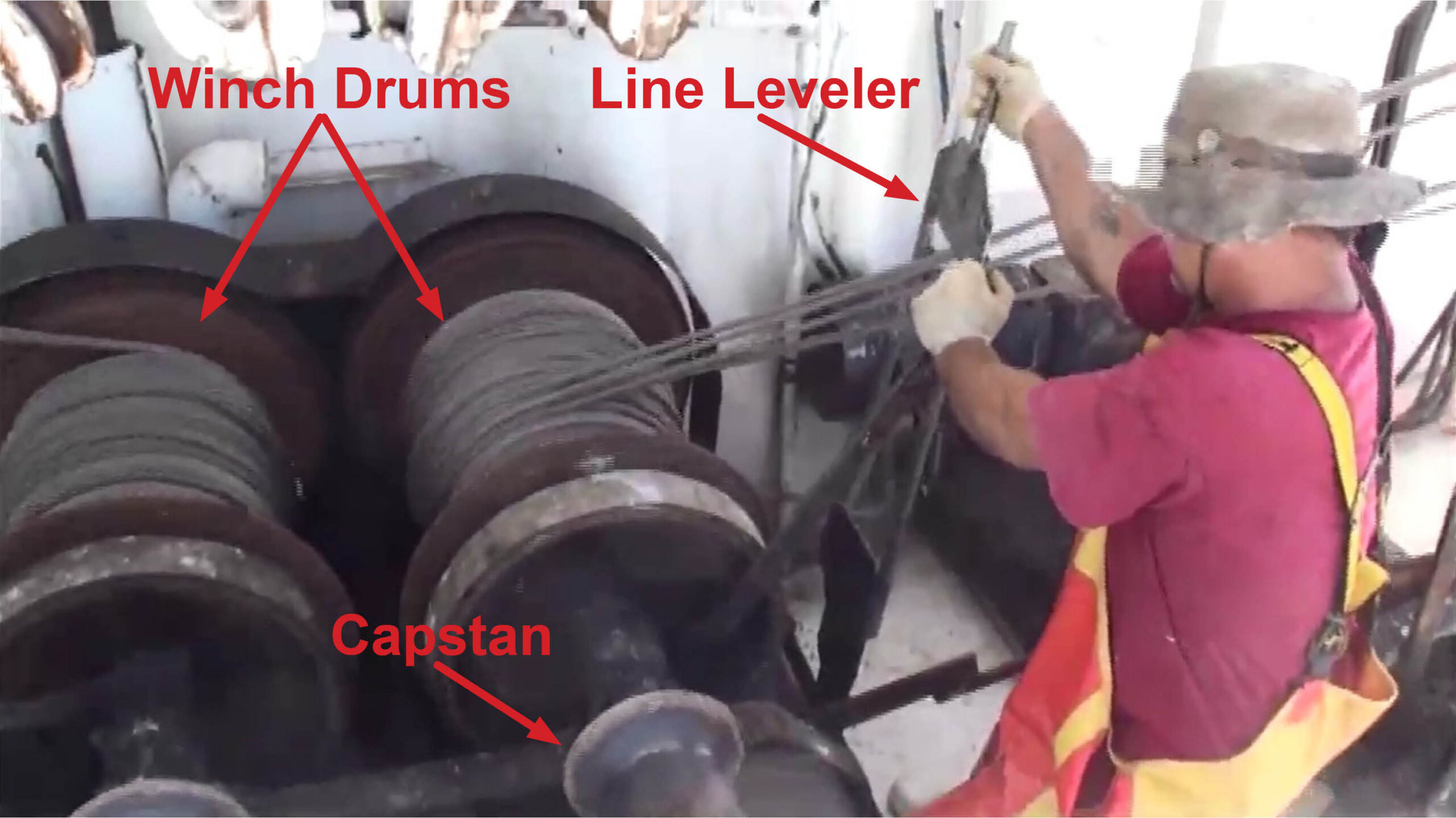
For example, in October 2024, a shrimp fisherman in Texas died when he became entangled in a deck winch. In response, the U.S. Coast Guard issued a Marine Safety Alert that "strongly recommends" installing winch guards and auxiliary stop devices to protect fishermen from entanglement hazards.5
NIOSH solutions: static winch guards
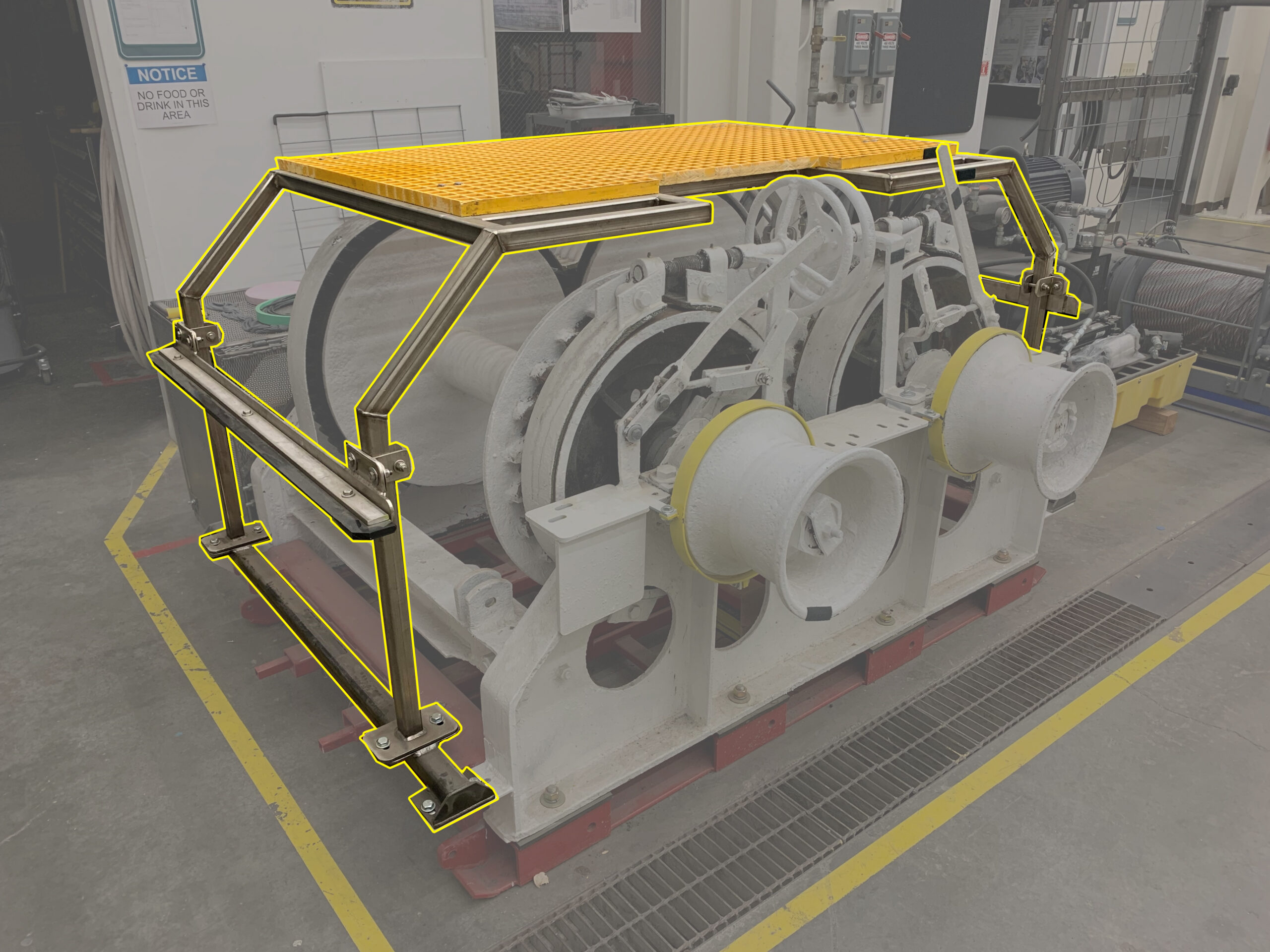
NIOSH engineers have helped to reduce entanglement risks by developing static winch guards for common types of main deck winches. The guards put a physical barrier between the rotating winch drums and the worker, preventing entanglements without getting in the way of fishing operations. The guards offer fishermen something to grab if they lose their balance while using the winch. The guards can also prevent injuries if clothing gets caught on a cable or line as it serves as a barrier to workers being pulled toward the rotating machine parts.
Dockside surveys revealed that the most common winch on vessels was the McElroy/Catchot Model 505* drum winch (see Image 2). In response, NIOSH engineers published free Fabrication and Installation guides for this winch, with instructions on how to build and install the guard.67 This guard can be installed on many winches currently used on shrimp vessels.
PtD using the hierarchy of controls
As with all PtD efforts, greater protection happens through using methods at higher levels of the hierarchy of controls.8 With a guard in place, worker safety no longer depends solely on administrative controls such as training and procedures. These guards are considered engineering controls and provide more effective protection that reduces the overall hazard of these winches as part of the guard design.
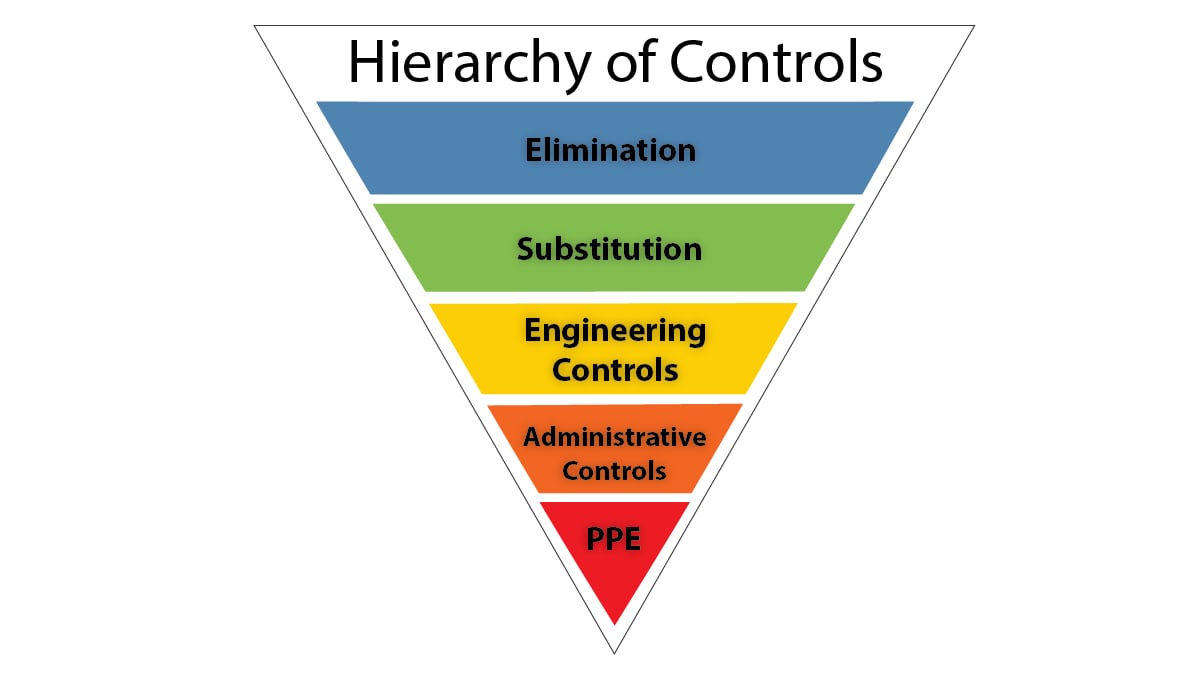
Removing or reducing the actual hazards workers face is the first consideration to controlling hazards. In this fishing example, other design changes might include better line-leveling systems, or even automatic line-levelers to remove workers from near the entanglement hazard. Further research and testing is needed before implementing these controls. Sometimes, however, not all options will be practical due to cost or other factors. When a hazard can't be eliminated, using multiple controls at different levels of the hierarchy may be needed to most effectively protect workers.
Some important administrative controls include reminding workers not to wear loose clothing that can get caught in moving equipment and, when possible, to avoid working alone on deck. If a worker gets caught in equipment, having deckhands trained in first aid—such as using tourniquets and performing CPR—can reduce the severity of their injuries. Managers and employers should train workers on how to stop the winch during an emergency.
While training and proper procedures are important, relying solely on administrative controls is less effective than using higher-level controls or using a combination of controls which can eliminate or reduce risk.
Conclusion
When facing a safety hazard, it's important to work with those in operations, maintenance, and design to explore all levels of the hierarchy of controls. This combined experience and expertise may lead to better solutions. As in the case of the NIOSH winch guard, placing physical barriers between workers and rotating machinery can reduce the chance for serious or fatal injuries to workers. This is Prevention through Design (PtD) in action!
To discuss safety and health in the commercial fishing industry, please contact NIOSH's Center for Maritime Safety and Health Studies (CMSHS) at cmshs@cdc.gov.
To discuss Prevention through Design, please contact NIOSH's PtD program at PtD@cdc.gov.
NIOSH, in partnership with the American Industrial Hygiene Association, the American Society of Safety Professionals, and the National Safety Council, presents an annual PtD Award. Nominations for the 2026 Award remain open through June 1. The award will be presented in September.
Author information
Theodore D. Teske, MA, Health Communication Specialist, NIOSH Western States Division.
Tristan Victoroff, MPH, Epidemiologist, NIOSH Western States Division.
Jonathan Bach, PE, CIH, CSP, Safety Engineer, NIOSH Division of Science Integration, retired.
*Mention of any company or product does not constitute endorsement by the National Institute for Occupational Safety and Health, Centers for Disease Control and Prevention.
- NIOSH [2013]. If You Have a MRSA Infection (Correctional Staff). Cincinnati, OH: U.S. Department of Health and Human Services, Centers for Disease Control and Prevention, National Institute for Occupational Safety and Health, DHHS (NIOSH) Publication No. 2013-126, https://www.cdc.gov/niosh/docs/2013-126/default.html.
- NIOSH [2024]. Safety guidelines: onboard hazards. Cincinnati, OH: U.S. Department Of Health and Human Services, Centers for Disease Control and Prevention, National Institute for Occupational Safety and Health, https://www.cdc.gov/niosh/fishing/onboard-hazards/index.html.
- NIOSH [2024]. Prevention through Design. Cincinnati, OH: U.S. Department of Health and Human Services, Centers for Disease Control and Prevention, National Institute for Occupational Safety and Health, https://www.cdc.gov/niosh/ptd/about/index.html.
- CDC [2013]. Fatal and nonfatal injuries involving fishing vessel winches—southern shrimp fleet, United States, 2000–2011. MMWR 62(09):157–60, https://www.cdc.gov/mmwr/preview/mmwrhtml/mm6209a1.htm.
- USCG [2024]. Marine safety alert: open rotary machine hazards. Washington, DC: U.S. Department of Homeland Security, United States Coast Guard, Inspections and Compliance Directorate, USCG Safety Alert 07-24, https://www.dco.uscg.mil/Portals/9/DCO%20Documents/5p/CG-5PC/INV/Alerts/USCGSA_0724.pdf.
- NIOSH [2024]. Fabrication guide: McElroy/Catchot model 505 winch guard. By Sweet D, Alexander J, Wimer B, Teske T, Kloczko D, Victoroff T. Spokane, WA: U.S. Department of Health and Human Services, Centers for Disease Control and Prevention, National Institute for Occupational Safety and Health, DHHS (NIOSH) Publication No. 2024-110, https://doi.org/10.26616/NIOSHPUB2024110.
- NIOSH [2024]. Installation guide: McElroy/Catchot model 505 winch guard. By Sweet D, Alexander J, Wimer B, Teske T, Kloczko D, Victoroff T. Spokane, WA: U.S. Department of Health and Human Services, Centers for Disease Control and Prevention, National Institute for Occupational Safety and Health, DHHS (NIOSH) Publication No. 2024-111, https://doi.org/10.26616/NIOSHPUB2024111.
- NIOSH [2024]. Hierarchy of controls. Cincinnati, OH: U.S. Department of Health and Human Services, Centers for Disease Control and Prevention, National Institute for Occupational Safety and Health, https://www.cdc.gov/niosh/hierarchy-of-controls/about/index.html.