



Key points
- Regardless of clade, monkeypox lesions present similarly; both clades of monkeypox can be spread, treated, and prevented the same way.
- Prodromal and respiratory symptoms may occur before lesions erupt.
- Monkeypox lesions can have a distinct look and feel and are often painful, but lesions caused by other diseases can present similarly.
- Lesions progress through 4 stages before scabbing over and desquamation.
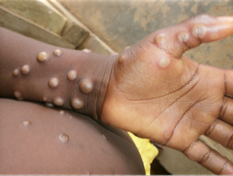
Overview
Monkeypox lesions are typically firm or rubbery, well-circumscribed, deep-seated, and often develop umbilication (resembles an indentation on the top of a lesion). Lesions are often described as painful until they crust over and become itchy. Some patients develop only a few lesions while others have disseminated lesions and ulcers.
The incubation period for monkeypox is 3-17 days, and the illness typically lasts 2-4 weeks. The severity of illness can depend upon the patient's underlying health and age. Treatment depends on the severity of the illness or risk for severe illness.
People with HIV-associated or other immunosuppression, who are pregnant or nursing, or who are under 18 years of age can be at increased risk of severe manifestations of monkeypox, which can be life-threatening.
Examples of monkeypox rashes
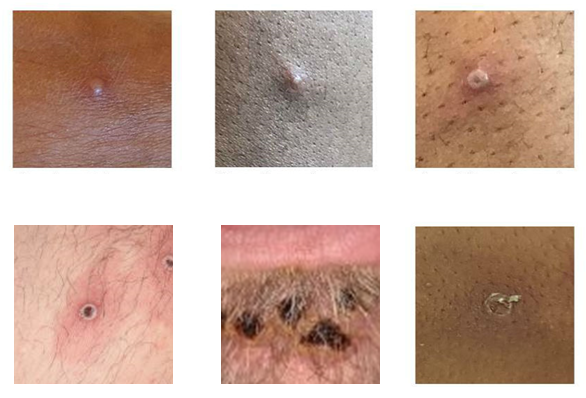
Photo credit: UK Health Security Agency
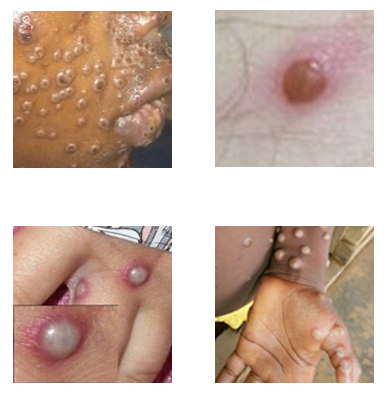
Disease stages
Caused by the monkeypox virus (MPXV), monkeypox disease is characterized by an incubation period, prodrome, and rash.
Incubation period
The incubation period for monkeypox is roughly 1-2 weeks. A person is not contagious during this period. CDC recommends physicians monitor patients who may have been exposed to MPXV up to 21 days after exposure.
Prodrome
People with MPXV infection often develop an early set of symptoms (prodrome). These symptoms may include fever, malaise, headache, sore throat, or cough, and lymphadenopathy (swollen lymph nodes). Lymphadenopathy is a characteristic feature of monkeypox, and lymph nodes may swell in the neck (submandibular & cervical), armpits (axillary), or groin (inguinal) and can occur on both sides of the body or just one. A person may be contagious during this period. Instruct patients to isolate if they develop prodromal symptoms.
Rash
In some cases of monkeypox, people have presented with a rash without a recognized prodrome. In many cases during the global clade II outbreak, patients have had only localized lesions and have not presented with the diffuse rash historically associated with monkeypox.
Lesions typically develop simultaneously and evolve together on any part of the body. The evolution of lesions progresses through four stages—macular, papular, vesicular, pustular—before scabbing over and desquamating. A person is contagious until all the scabs have fallen off, revealing a fresh layer of intact skin underneath.
Regardless of clade I or clade II MPXV infection:
- Lesions often occur in the genital and anorectal areas or in the mouth.
- Patients regularly present with rectal symptoms (e.g., purulent or bloody stools, rectal pain, or rectal bleeding).
- Rash may be confined to only a single lesion or a few lesions.
- Rash is not always disseminated across the body.
- Rash may or may not appear on palms and soles.
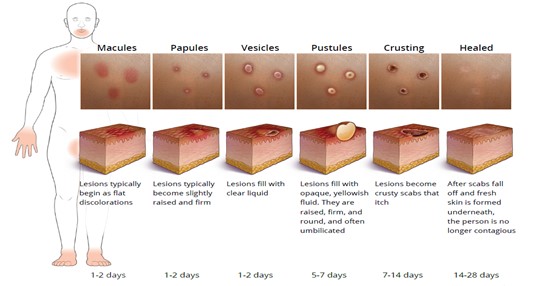
| Stage | Stage Duration | Characteristics |
|---|---|---|
| Enanthem |
|
|
| Macules | 1−2 days |
|
| Papules | 1−2 days |
|
| Vesicles | 1−2 days |
|
| Pustules | 5−7 days |
|
| Scabs | 7−14 days |
|
*This is a typical timeline, but timeline can vary.
Rash resolves
Pitted scars and/or areas of lighter or darker skin may remain after scabs have fallen off. Once all scabs have fallen off and a fresh layer of skin has formed, a person is no longer considered contagious.
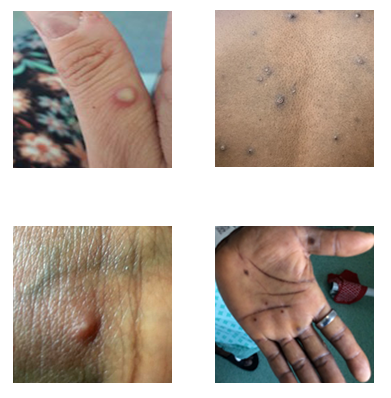
Photo Credit: NHS England High Consequence Infectious Diseases Network