 An official website of the United States government



Notes from the Field: Expanding Birthing Hospital Enrollment in the Vaccines for Children Program to Increase Infant Immunization Against Respiratory Syncytial Virus — United States, October 2023–March 2025
Weekly / November 20, 2025 / 74(37);589–591
Kerry E. Olmsted, MPH1; Terrin Ramsey-Omonua, MSN-PH1; Ebony S. Thomas, MPH1; James T. Lee, MD1; Llandess Owens, MPH2; Sam Graitcer, MD1; Jamie Mells, PhD1 (View author affiliations)
View suggested citationSummary
What is already known about this topic?
Nirsevimab, a long-acting monoclonal antibody that protects infants against respiratory syncytial virus (RSV), should be administered within 1 week after birth to infants not protected by maternal RSV vaccination. The Vaccines for Children (VFC) program provides CDC-purchased immunizations, including nirsevimab, to eligible children at no cost.
What is added by this report?
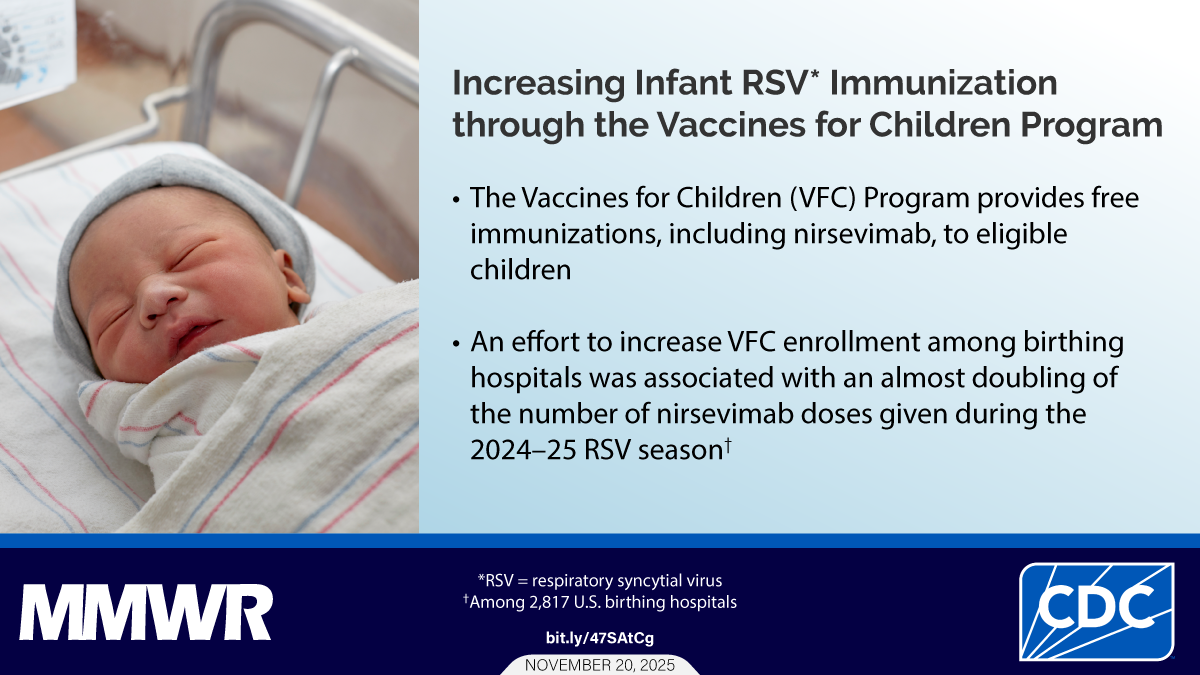
A CDC effort with professional organizations and health departments to enroll birthing hospitals in VFC was associated with an increase in enrolled birthing hospitals from 763 (27.1% of 2,817 facilities) at the beginning of the 2023–24 RSV season to 1,021 (36.2%) by the end of the 2024–25 RSV season. The number of nirsevimab doses ordered approximately doubled.
What are the implications for public health practice?
Continued efforts to increase birthing hospital VFC enrollment can support expanded access to RSV immunization.
Altmetric:
Respiratory syncytial virus (RSV), the leading cause of hospitalization among U.S. infants, results in 50,000–80,000 associated hospitalizations and 100–300 deaths among children aged <5 years each year (1). In 2023, the Advisory Committee on Immunization Practices (ACIP) recommended two options for preventing severe RSV in infants: maternal RSV vaccination during pregnancy (2) or administration of nirsevimab, a long-acting monoclonal antibody to infants (1). Nirsevimab is recommended for infants aged <8 months during their first RSV season (October–March in most of the United States); ideally, it should be administered during the birth hospitalization or within the first week of life. In September 2023, ACIP passed a resolution to add nirsevimab to the Vaccines for Children (VFC) Program, a public-private partnership that provides CDC-purchased vaccines to VFC-eligible children (those who are uninsured or underinsured, insured through Medicaid, or who are American Indian or Alaska Native) at no cost. Approximately one half (52.2%) of U.S. children aged 19–35 months are VFC-eligible, and among those, 93.4% are insured by Medicaid (3). Medicaid-insured infants have a higher incidence of severe RSV infection than do privately insured infants (4). Providers enrolled in the VFC program are able to administer nirsevimab at no cost to eligible children. Enrollment of birthing hospitals in VFC thus has the potential to expand infant immunization against RSV. This report describes enrollment of U.S. birthing hospitals (those with more than one birth during the previous year or at least one registered maternity bed) in the VFC program since the introduction of nirsevimab.
Investigation and Findings
Enrollment of Birthing Hospitals in VFC
Birthing hospitals are well positioned to provide timely access to nirsevimab, perhaps especially to Medicaid-insured infants who are less likely to receive a pediatric checkup within the first week of life than privately insured infants (5) and who therefore might miss the recommended window for receiving nirsevimab if it is not administered during the birth hospitalization. Enrolling as a VFC provider allows birthing hospitals to offset the high cost of nirsevimab.*
In 2023, CDC undertook efforts to facilitate birthing hospital enrollment in the VFC program. In April 2023, CDC held focus groups with 11 U.S. jurisdictions on facilitators and barriers to enrolling birthing hospitals in VFC. Many jurisdictions reported challenges in developing relationships with birthing hospitals, a need for capacity building within jurisdictions, and a need for flexible VFC policies. In response, to streamline administrative processes for providers, CDC updated VFC policies to facilitate nirsevimab ordering and inventory management by VFC providers and encouraged birthing hospitals to implement VFC policies reducing the required number of stocked immunization products to only those recommended within 1 week of birth (i.e., hepatitis B vaccine and nirsevimab), rather than all recommended childhood immunizations.
Beginning in August 2023, CDC partnered with professional organizations and health departments† to support birthing hospital enrollment in VFC through development and dissemination of educational and training resources and establishment of learning collaboratives that included facilitated discussions for sharing lessons learned and promising practices. U.S. birthing hospital enrollment in VFC and doses of nirsevimab purchased by these facilities were estimated across the two RSV seasons following the recommendation for nirsevimab for infants (October 1, 2023–March 31, 2024 [2023–24] and October 1, 2024–March 31, 2025 [2024–25]).
Identification of Birthing Hospitals Enrolled in VFC
A list of U.S. birthing hospitals was created using the 2022 American Hospital Association Annual Survey and the 2024 Maternity Practices in Infant Nutrition and Care survey to match birthing hospitals to enrolled VFC hospitals§; jurisdictions¶ reviewed data for accuracy. This activity was reviewed by CDC, deemed not research, and was conducted consistent with applicable federal law and CDC policy.**
Birthing Hospital Enrollment During the 2023–24 and 2024–25 RSV Seasons
Among all 2,817 U.S. birthing hospitals, the number enrolled in VFC increased from 763 (27.1%) at the beginning of the 2023–24 RSV season to 1,021 (36.2%) by the end of the 2024–25 season (Table), covering approximately 41.8% of U.S. births in hospitals. The largest increase occurred among jurisdictions in the U.S. Census Bureau Northeast Region, from 158 (44.4%) birthing hospitals to 266 (74.5%). During the 2023–24 season, birthing hospitals ordered 46,738 VFC doses of nirsevimab; during the 2024–25 season, the number of doses ordered more than doubled, to 102,057.
Preliminary Conclusions and Actions
Efforts to enroll birthing hospitals in VFC depend on jurisdiction staff members who administer the VFC program and understand its requirements. Starting July 1, 2025, as a condition of funding support for VFC, CDC requires that each jurisdiction enroll ≥30% of its birthing hospitals in VFC; as of March 31, 2025, 39 of 61 (63.9%) jurisdictions have met this target. Clesrovimab, a new RSV monoclonal antibody, was recommended by ACIP in June 2025 and will be available as an alternative to nirsevimab through the VFC program. CDC continues to partner with jurisdictions and professional organizations to address barriers to VFC enrollment for birthing hospitals and share best practices. Birthing hospital VFC enrollment can support expanded access to RSV immunization among infants at highest risk for severe disease.
Acknowledgments
City, state, and territorial health departments; Sarah Canastra, Eve Lee, Michael Nelson, Iman Nematollahi, Data Informed Technical Assistance team, Deloitte Consulting, LLC; the American Hospital Association.
Corresponding author: Kerry E. Olmsted, seu2@cdc.gov.
1Immunization Services Division, National Center for Immunization and Respiratory Diseases, CDC; 2VAAS Professionals, LLC, Atlanta, Georgia.
All authors have completed and submitted the International Committee of Medical Journal Editors form for disclosure of potential conflicts of interest. No potential conflicts of interest were disclosed.
* Before 2023, hepatitis B vaccine, a low-cost immunization, was the only immunization recommended at birth; thus, birthing hospitals had less financial incentive to enroll in VFC. Whereas hepatitis B vaccine costs approximately $15 per dose, nirsevimab costs approximately $415 per dose in the VFC program (CDC Vaccine Price List as of April 1, 2025). Clesrovimab, a new RSV monoclonal antibody product, was recommended by ACIP in June 2025; VFC pricing information is not yet available.
† American Hospital Association, Association of Immunization Managers, America’s Health Insurance Plans, American College of Obstetricians and Gynecologists, American Academy of Pediatrics, American College of Nurse-Midwives, Centers for Medicare & Medicaid Services, and Perinatal Quality Collaboratives.
§ String matching (i.e., searching for a smaller text string within a larger string) using Python (version 3.12; Python Software Foundation) connected birthing hospitals to enrolled VFC providers using hospital names, contact information, and locations. VFC providers were matched to the same list of birthing hospitals at both time points; the total number of birthing hospitals did not change meaningfully from the beginning of the 2023–24 RSV season to the end of the 2024–25 RSV season.
¶ Birthing hospital VFC enrollment is counted by the 61 jurisdictions with VFC funding: all 50 states, the District of Columbia, five U.S. cities (Chicago, Houston, New York City, Philadelphia, and San Antonio), and five U.S. territories (American Samoa, Guam, the Northern Mariana Islands, Puerto Rico, and the U.S. Virgin Islands). VFC is updating its data system to better capture services offered and birthing hospital status.
** 45 C.F.R. part 46.102(l)(2), 21 C.F.R. part 56; 42 U.S.C. Sect. 241(d); 5 U.S.C. Sect. 552a; 44 U.S.C. Sect. 3501 et seq.
References
- Jones JM, Fleming-Dutra KE, Prill MM, et al. Use of nirsevimab for the prevention of respiratory syncytial virus disease among infants and young children: recommendations of the Advisory Committee on Immunization Practices—United States, 2023. MMWR Morb Mortal Wkly Rep 2023;72:920–5. https://doi.org/10.15585/mmwr.mm7234a4 PMID:37616235
- Fleming-Dutra KE, Jones JM, Roper LE, et al. Use of the Pfizer respiratory syncytial virus vaccine during pregnancy for the prevention of respiratory syncytial virus–associated lower respiratory tract disease in infants: recommendations of the Advisory Committee on Immunization Practices—United States, 2023. MMWR Morb Mortal Wkly Rep 2023;72:1115–22. https://doi.org/10.15585/mmwr.mm7241e1 PMID:37824423
- Valier MR, Yankey D, Elam-Evans LD, et al. Vital signs: trends and disparities in childhood vaccination coverage by Vaccines for Children program eligibility—National Immunization Survey-Child, United States, 2012–2022. MMWR Morb Mortal Wkly Rep 2024;73:722–30. https://doi.org/10.15585/mmwr.mm7333e1 PMID:39173180
- Suh M, Movva N, Jiang X, et al. Respiratory syncytial virus burden and healthcare utilization in United States infants <1 year of age: study of nationally representative databases, 2011–2019. J Infect Dis 2022;226(Suppl 2):S184–94. https://doi.org/10.1093/infdis/jiac155 PMID:35968879
- Nelson CB, Brady BL, Richards M, et al. Optimal site of care for administration of extended half-life respiratory syncytial virus (RSV) antibodies to infants in the United States (US). Vaccine 2023;41:5820–4. https://doi.org/10.1016/j.vaccine.2023.06.089 PMID:37586957

Abbreviations: RSV = respiratory syncytial virus; VFC = Vaccines for Children.
* The total number of known birthing hospitals on March 31, 2025, was used as the denominator for both time points. The denominator did not change meaningfully between seasons.
† Jurisdiction did not provide additional feedback on its birthing hospital enrollment data.
§ U.S. Census Bureau regions and divisions of the United States excludes U.S. territories.
Suggested citation for this article: Olmsted KE, Ramsey-Omonua T, Thomas ES, et al. Notes from the Field: Expanding Birthing Hospital Enrollment in the Vaccines for Children Program to Increase Infant Immunization Against Respiratory Syncytial Virus — United States, October 2023–March 2025. MMWR Morb Mortal Wkly Rep 2025;74:589–591. DOI: http://dx.doi.org/10.15585/mmwr.mm7437a2.
MMWR and Morbidity and Mortality Weekly Report are service marks of the U.S. Department of Health and Human Services.
Use of trade names and commercial sources is for identification only and does not imply endorsement by the U.S. Department of
Health and Human Services.
References to non-CDC sites on the Internet are
provided as a service to MMWR readers and do not constitute or imply
endorsement of these organizations or their programs by CDC or the U.S.
Department of Health and Human Services. CDC is not responsible for the content
of pages found at these sites. URL addresses listed in MMWR were current as of
the date of publication.
All HTML versions of MMWR articles are generated from final proofs through an automated process. This conversion might result in character translation or format errors in the HTML version. Users are referred to the electronic PDF version (https://www.cdc.gov/mmwr) and/or the original MMWR paper copy for printable versions of official text, figures, and tables.
Questions or messages regarding errors in formatting should be addressed to mmwrq@cdc.gov.