



At a glance
- Laboratory Leadership Service (LLS) officers can provide short-term assistance to public health laboratories and jurisdictions.
- LLS Lab-Aid service can be delivered on-site or remotely.
- Learn how to request a Lab-Aid or other LLS service.
Requesting a Lab-Aid
What Lab-Aid is
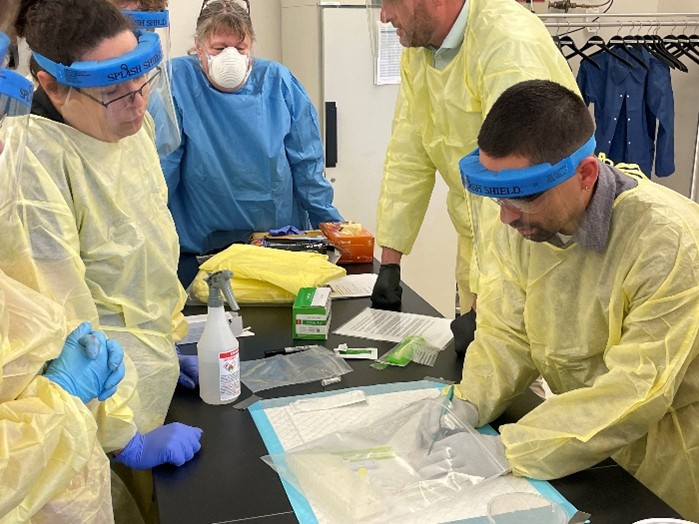
A Lab-Aid is a mechanism for providing rapid, short-term (up to 3 weeks) support to state, territorial, local, tribal, and federal public health labs for critical laboratory testing or operational needs. A Lab-Aid provides on-site or remote technical assistance by trained Laboratory Leadership Service (LLS) officers and appropriate CDC subject matter experts.
Activities LLS officers can perform during a Lab-Aid
During a Lab-Aid, an LLS officer takes a leadership role, supported by a CDC subject matter expert, to address an urgent public health concern. A Lab-Aid may involve:
- Conducting lab safety risk assessments.
- Advising on lab quality issues or systems to help improve the reliability and reproducibility of lab data.
- Standing up or strengthening the lab component of a surveillance program.
- Assisting with bioinformatics or advanced molecular detection (AMD) workflows or analyses.
- Providing lab expertise or assistance for outbreak investigations.
- Capacity building or laboratory operations support.
Who participates
A Lab-Aid team includes at least one LLS officer and one or more CDC laboratory subject matter experts based on the laboratory’s needs. The Lab-Aid team collaborates closely with the staff of the public health laboratory requesting assistance. The requesting public health laboratory provides overall leadership for the Lab-Aid while the Lab-Aid team provides technical assistance.
Who can request a Lab-Aid
A Lab-Aid must be requested by the public health laboratory director.
The role of the requesting public health laboratory
The public health laboratory requesting the Lab-Aid provides overall leadership of the assistance while benefitting from a collaborative relationship with the Lab-Aid team. The public health laboratory generally retains custody and control over all data collected as part of the association. After the Lab-Aid is completed, the public health laboratory can request CDC’s continued collaboration and assistance in:
- Data analysis.
- Report writing.
- Presentation preparation.
- Additional programmatic technical assistance.
How a public health laboratory can request a Lab-Aid
- Contact the LLS program (LLS@cdc.gov) or a collaborating CDC subject matter expert to discuss Lab-Aid needs. LLS welcomes the opportunity to discuss the needs not listed here.
- The requesting laboratory or jurisdiction sends a letter of invitation to the LLS program (LLS@cdc.gov).
- The LLS program identifies available officer and CDC subject matter expert availability before approving the Lab-Aid.
- The LLS program approves the Lab-Aid.
How Lab-Aids benefit public health
A Lab-Aid benefits public health in several ways. Lab-Aids can:
- Streamline access to CDC subject matter experts and laboratory resources.
- Increase the technical capacity and workforce available for rapid laboratory response.
- Build capacity for laboratory safety and quality through collaboration.
- Enhance relationships between CDC and public health laboratories.
The difference between a Lab-Aid and an Epi-Aid
A Lab-Aid focuses on addressing public health laboratory needs and is not limited to urgent public health responses, such as outbreak investigations.
An Epi-Aid provides rapid, short-term epidemiologic assistance by EIS officers for response to an urgent public health problem. LLS officers provide laboratory support for some Epi-Aids, as needed.
Contact LLS@cdc.gov for any questions or need additional information and guidance.
Request LLS services and support
LLS officers provide laboratory expertise and support to CDC, state, tribal, local, and territorial public health laboratories, and other public health partners. Click on one of the links below to request assistance.
Urgent assistance (Lab-Aid)
Find short-term laboratory assistance.
Presentation request
Request a speaker or presentation.
Media requests
Request interviews and information for news media stories.
Contact us
Request program information or speak with an LLS officer or alumnus.