



At a glance
- Nursing home residents are at risk of developing infections that can lead to sepsis, which is a medical emergency requiring immediate attention to prevent severe morbidity and mortality.
- The Sepsis Prevention Assessment Tool (SPAT) for Nursing Homes identifies gaps in sepsis policies, training, and practices in nursing homes that can be targeted to improve infection prevention, sepsis recognition, and health outcomes.
- CDC is available to provide technical assistance to facilities and public health partners implementing this resource.
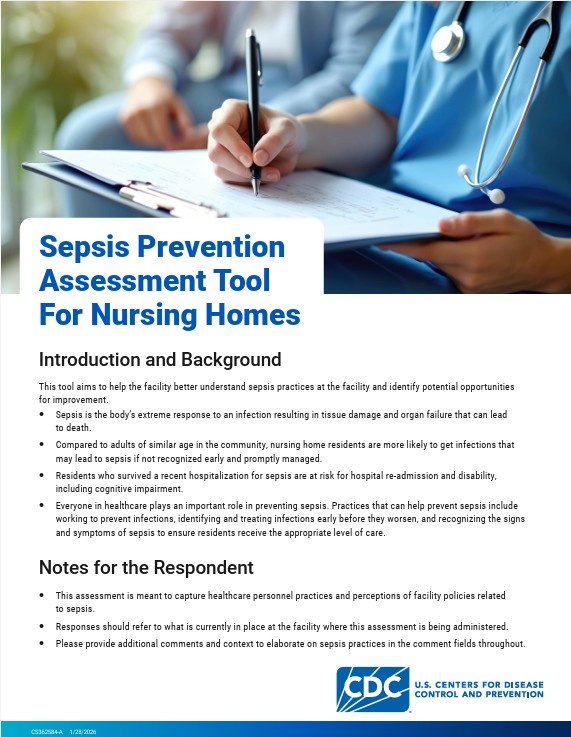
SPAT-NH includes
![[thumbnail] (hidden)](/sepsis/media/images/SPAT-Nursing-Homes-Deep-Dive-Thumb.jpg)
![[thumbnail] (hidden)](/sepsis/media/images/SPAT-Deployment-Packet-Thumb.jpg)
![[thumbnail] (hidden)](/sepsis/media/images/SPAT-Gap-Prioritization-Worksheet-Thumb.jpg)
![[thumbnail] (hidden)](/sepsis/media/images/SPAT-Implementation-Guide-Thumb.jpg)
Assessment Details
Purpose
Sepsis is a life-threatening medical emergency; it is the body's extreme response to infection and can lead to organ failure and death. Nursing home residents are at increased risk for infections that can lead to sepsis due to more common medical conditions and frequent interactions in healthcare settings where infections can spread. The Sepsis Prevention Assessment Tool for Nursing Homes identifies gaps in sepsis policies, training, and practices in nursing homes that can be targeted to improve infection prevention, sepsis recognition, and health outcomes.
Contents
This resource includes instructions to assist with preparing for and conducting the Sepsis Prevention Assessment Tool for Nursing Homes, analyzing and sharing assessment data, and preparing for next steps.
The Sepsis Prevention Assessment Tool for Nursing Homes includes several sections that are similar to the Hospital Sepsis Program Core Elements; however, this tool is modified to apply more specifically to the nursing home healthcare setting including:
- Facility Leadership Commitment and Accountability
- Prevention Education and Feedback
- Screening, Identification, and Care Coordination
- Tracking and Reporting
- Infection Prevention
How to use
- Prepare to use the Sepsis Prevention Assessment Tool for Nursing Homes by reviewing the Deployment Packet for the Sepsis Prevention Assessment Tool for Nursing Homes.
- The Sepsis Prevention Assessment Tool for Nursing Homes can be distributed via paper and/or electronically. For assistance with electronic distribution methods, reach out to HAIPrevention@cdc.gov.
- Identify multiple frontline healthcare personnel to complete the Sepsis Prevention Assessment Tool for Nursing Homes. This allows for a robust analysis of gaps in policies, training, and practices by accounting for multiple viewpoints. The more assessments collected, the greater the ability to identify gaps and further target prevention efforts.
- The Director of Nursing (DON) or Infection Preventionist at the facility should complete the Nursing Home Sepsis Prevention Deep Dive assessment. The Nursing Home Sepsis Prevention Deep Dive is meant to be completed just once per facility and provides a more detailed review of policies.
- Once results from assessments are available, they can be used to guide changes in preventing sepsis using quality improvement methods. Several guides to implement changes are available at CDC:
- Gap Prioritization Worksheet for the Sepsis Prevention Assessment Tool (SPAT): a worksheet to identify and prioritize gaps in sepsis policies or practices after the Sepsis Prevention Assessment Tool for Nursing Homes has been completed.
- Implementation Guide for the Sepsis Prevention Assessment Tool (SPAT): a guide with links to resources for nursing homes to improve practices related to sepsis organized by SPAT domain.