



About
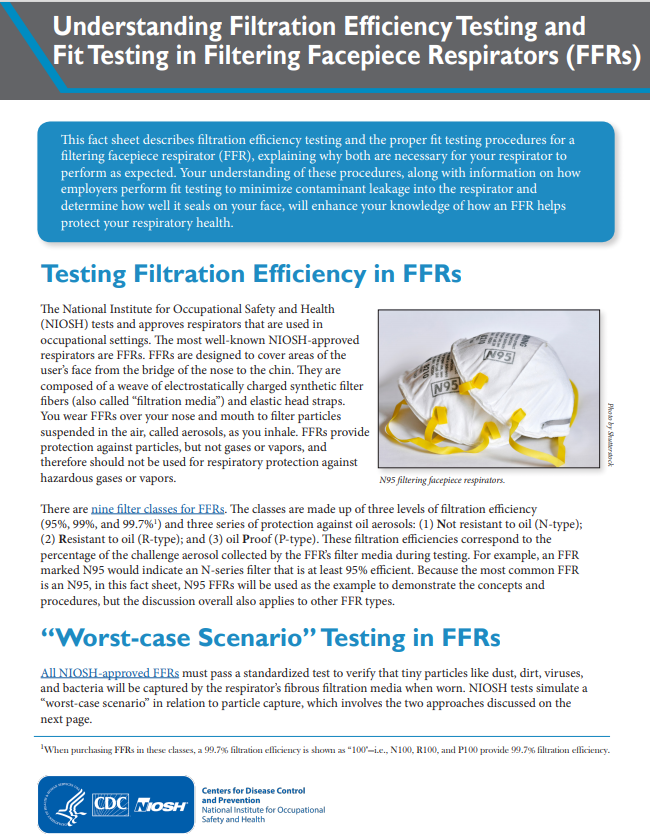
This fact sheet describes filtration efficiency testing and the proper fit testing procedures for a filtering facepiece respirator (FFR), explaining why both are necessary for a respirator to perform as expected. A respirator user’s understanding of these procedures and how employers perform fit tests to minimize contaminant leakage into the respirator will enhance the user’s knowledge of how an FFR helps to protect respiratory health.
Additional information
Suggested citation
NIOSH [2021]. Understanding filtration efficiency testing and fit testing in filtering facepiece respirators (FFRs). By Schall J, Coffey C. Pittsburgh, PA: U.S. Department of Health and Human Services, Centers for Disease Control and Prevention, National Institute for Occupational Safety and Health. DHHS (NIOSH) Publication No. 2021-123 (revised 11/2021), https://doi.org/10.26616/NIOSHPUB2021123revised112021
| Revision Date | Revisions | Citation of Revision |
| September, 2021 (original) | NIOSH [2021]. Understanding filtration efficiency testing and fit testing in filtering facepiece respirators (FFRs). By Schall J, Coffey C. Pittsburgh, PA: U.S. Department of Health and Human Services, Centers for Disease Control and Prevention, National Institute for Occupational Safety and Health. DHHS (NIOSH) Publication No. 2021-123, https://doi.org/10.26616/NIOSHPUB2021123 | |
|
September, 2021
|
On page 1, there are references to three levels of filtration efficiencies for the nine filter classes of filtering facepiece respirators. The original references to filtration efficiencies incorrectly reported one percentage to be 99.7%. This percentage has been corrected to 99.97% | NIOSH [2021]. Understanding filtration efficiency testing and fit testing in filtering facepiece respirators (FFRs). By Schall J, Coffey C. Pittsburgh, PA: U.S. Department of Health and Human Services, Centers for Disease Control and Prevention, National Institute for Occupational Safety and Health. DHHS (NIOSH) Publication No. 2021-123 (revised 9/2021), https://doi.org/10.26616/NIOSHPUB2021123revised092021 |
| November, 2021 | On page 3, the photo of a test subject participating in a quantitative fit test was cropped so that only the top portion of the tube assembly is visible. A footnote was also added after the paragraph describing the quantitative fit test to clarify that, during the test, strain relief must be provided so the weight of the tube assembly does not artificially lower the fit factor by negatively affecting the seal of the respirator to the face. | NIOSH [2021]. Understanding filtration efficiency testing and fit testing in filtering facepiece respirators (FFRs). By Schall J, Coffey C. Pittsburgh, PA: U.S. Department of Health and Human Services, Centers for Disease Control and Prevention, National Institute for Occupational Safety and Health. DHHS (NIOSH) Publication No. 2021-123 (revised 11/2021), https://doi.org/10.26616/NIOSHPUB2021123revised112021 |