



About
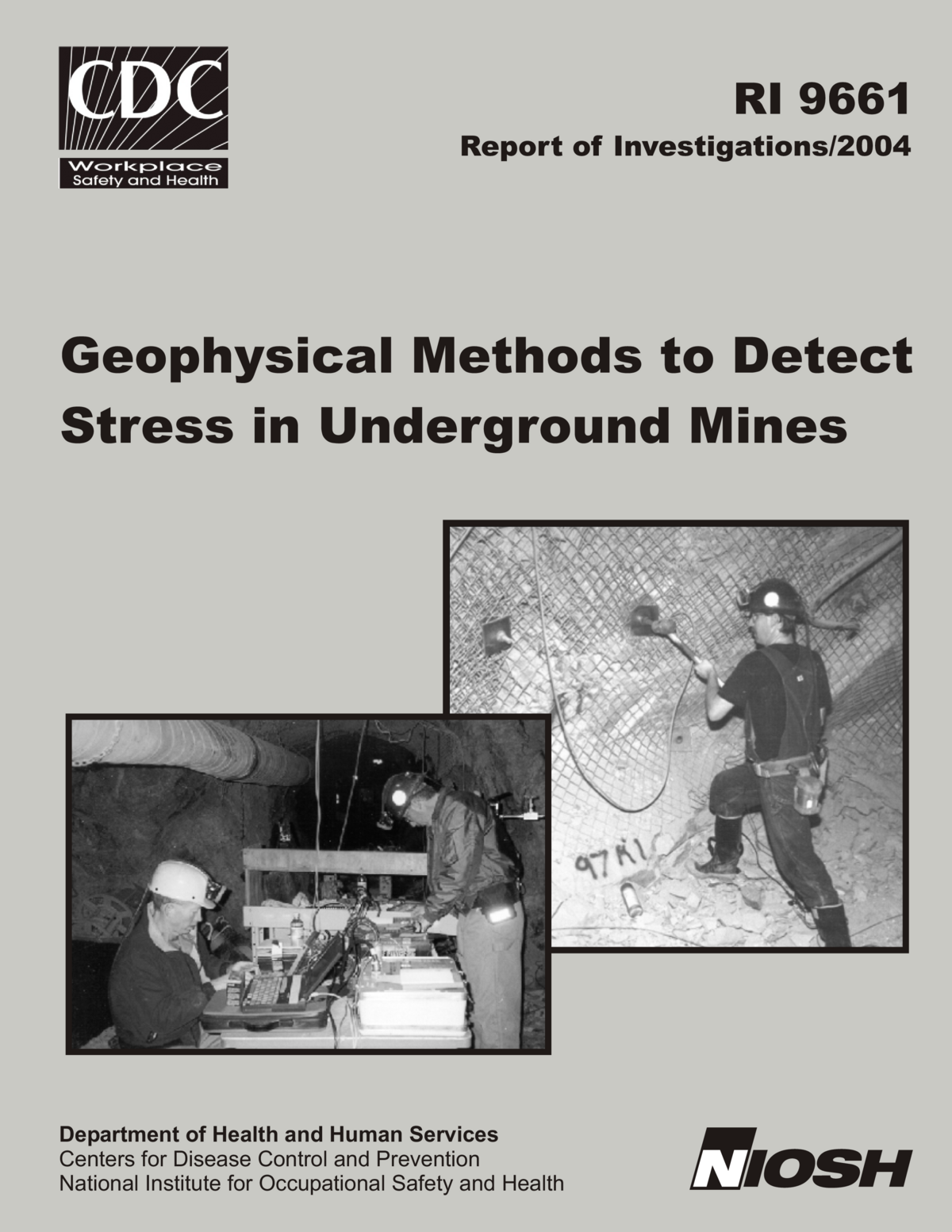
Highly stressed rock in stopes continues to be a primary safety risk for miners in underground mines because this condition can result in failures of ground that lead to both injuries and death. Personnel from the Spokane Research Laboratory of the National Institute for Occupational Safety and Health studied two methods for identifying stress in rock. A seismic tomographic survey, finite-difference analysis, laboratory measurements of compression wave (ultrasonic) velocities in rock cores, and site geology were integrated to evaluate the use of seismic tomography for identifying induced pressures in an underground pillar at the Edgar Mine, Idaho Springs, Colorado. Electromagnetic (EM) emissions were also investigated in the Galena Mine, a deep underground mine in Idaho, in an effort to determine if these emissions could be used as indicators of impending catastrophic ground failure. Results of this research indicated that (1) seismic tomography appears to be a useful tool for determining relative stress in underground pillars, while (2) EM emissions do not appear to be significant precursors of impending catastrophic ground failure.
Suggested citation
NIOSH [2004]. Geophysical methods to detect stress in underground mines. By Scott DF, Williams TJ, Tesarik D, Denton DK, Knoll SJ, Jordan J. Spokane, WA: U.S. Department of Health and Human Services, Centers for Disease Control and Prevention, National Institute for Occupational Safety and Health, DHHS (NIOSH) Publication No. 2004-133.
This page was last updated on this date. Updates may include minor edits, image changes, or other modifications to page content.
The information on this page was last reviewed by subject matter experts to ensure accuracy.