



What to know
- NIOSH approves respirators that help protect emergency responders and workers from chemical, biological, radiological, and nuclear (CBRN) hazards.
- These hazards can be encountered during disasters, emergencies, or intentional attacks.
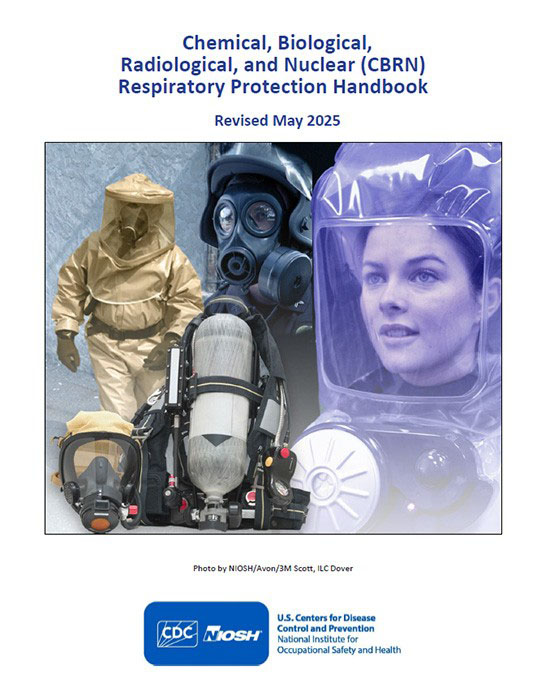
- NIOSH recently released an updated version of its Chemical, Biological, Radiological, and Nuclear (CBRN) Respiratory Protection Handbook.
Summary
NIOSH approves respirators that help protect emergency responders and workers from chemical, biological, radiological, and nuclear (CBRN) hazards. These hazards can be encountered during disasters, emergencies, or intentional attacks. NIOSH recently released an updated version of its Chemical, Biological, Radiological, and Nuclear (CBRN) Respiratory Protection Handbook, previously updated in 2018. This handbook is a key resource for emergency responders and safety professionals that manage respirator programs and are responsible for the selection, use, and maintenance of CBRN respirators.
As of 8/1/25, there are over 500 respirators with CBRN protections approved by NIOSH [NIOSH 2019] including:
- 436 self-contained breathing apparatus (SCBAs) approvals
- 22 air-purifying respirators (APRs) approvals
- 33 air-purifying escape respirators (APERs) approvals
- 8 powered air-purifying respirators (PAPRs) approvals [NIOSH
Background
The 2025 handbook updates and replaces the 2018 version and reflects findings from a recent multi-agency hazard assessment conducted alongside the Department of Homeland Security and the Department of Defense. The findings of this hazard assessment prompted NIOSH to expand its CBRN Air-Purifying Respirators (APR) Protection List, ensuring coverage of new and emerging threats while reaffirming the suitability of current testing chemical agents. This effort aligns with Executive Order 14303 ensuring transparency, rigor and impactful science to protect emergency responders.
The updated CBRN APR Protection List, contained in the handbook, also replaces the earlier interim guidance from 2005.
Key handbook updates
- Expanded Hazard List: The number of hazards in the CBRN APR Protection List has more than doubled, going from 139 to 286.
- Reaffirmation of Testing Agents: The original 11 test representative agents (TRAs) remain effective for evaluating CBRN respirator performance, representing the most probable hazards emergency responders may face.
- Updated Industry Standards: This Handbook includes updates to National Fire Protection Association (NFPA) standards related to CBRN respirator performance.
Bottom line: The list of hazards was expanded from 139 to 286, but the 11 original test representative agents were still found to be effective. That means no changes were needed to test procedures or standards.
A closer link: the CBRN protection list
This CBRN APR Protection List was originally developed in the early 2000s as part of a collaboration with partners including the Department of Defense, Department of Energy, and Department of Justice. The goal was to identify the types of CBRN hazards most likely to be encountered by emergency responders, in order to appropriately develop performance requirements against these hazards.
The list is at the core of how NIOSH evaluates and approves respirators for use in emergencies involving hazardous substances. Using the list of test representative agents, it provides the approved CBRN canister that should provide the wearer protection against the agent.
Why update the handbook?
CBRN threats evolve over time, and NIOSH regularly reviews and updates its list to make sure it remains accurate. Between 2016 and 2019, NIOSH worked with the Department of Defense and Department of Homeland Security to identify new and emerging hazards. This partnership led to the thorough assessment of 238 potential threats: 192 chemicals and 46 radiological hazards.
Each hazard was identified using a four-step evaluation (Figure 1):
- Compile its chemical and physical properties.
- Evaluate actual or expected filtration behavior in CBRN canisters (e.g., physical adsorption, chemisorption, or mechanical filtration).
- Assign to one of NIOSH's seven Chemical Families.
- Compare against the existing test representative agents to determine if new agents were needed.
This evaluation also confirmed that the 11 test representative agents NIOSH currently uses to evaluate CBRN canisters are appropriate.
This documented evaluation process can be used for future hazard assessments. The results can be used by manufacturers for any potential design modification needs and emergency responders can use them to ensure awareness of their respiratory protection limitations.
Author information
Lee Greenawald, PhD, is the former Evaluation and Testing Branch Chief in the NIOSH National Personal Protective Technology Laboratory
Aris Copeland, BA, is a Health Communication Intern in the NIOSH National Personal Protective Technology Laboratory
Additional resources
- Fact Sheets
- Webpages
- Book
- Cloonan, T.K., Palya, F., Stein, R. Coffey, C.C. Wizner, K.L., Greenawald, L., Szalajda, J.V. (2018). Respiratory Protection for Emergency Responders Handbook of Respiratory Protection: Safeguarding Against Current and Emerging Hazards (429-451). FL: CRC Press.
- NIOSH [2025]. Chemical, Biological, Radiological, and Nuclear (CBRN) Respiratory Protection Handbook. By Szalajda JV, Greenawald LA, Janssen L, Johnson AT, Johnson JS, Mansdorf SZ, Medici OR, Metzler RW, Rehak TR. Pittsburgh, PA: U.S. Centers for Disease Control and Prevention, National Institute for Occupational Safety and Health, DHHS (NIOSH) Publication No. 2025-111 (revised 09/2025).
- Lee A. Greenawald, Christopher J. Karwacki, Frank Palya, Matthew A. Browe, David Bradley & Jonathan V. Szalajda [2020] Conducting an evaluation of CBRN canister protection capabilities against emerging chemical and radiological hazards, Journal of Occupational and Environmental Hygiene, 17:10, 480-494, DOI: 10.1080/15459624.2020.1798452.
- NIOSH [2005]. NIOSH Interim Guidance on the Use of Chemical, Biological, Radiological and Nuclear (CBRN) Full Facepiece, Air-Purifying Respirators/Gas Masks Certified Under 42 CFR Part 84.
- NIOSH [2018]. Chemical, Biological, Radiological, and Nuclear (CBRN) Respiratory Protection Handbook. By Janssen L, Johnson AT, Johnson JS, Mansdorf SZ, Medici OR, Metzler RW, Rehak TR, Szalajda JV. Pittsburgh, PA: U.S. Department of Health and Human Services, Centers for Disease Control and Prevention, National Institute for Occupational Safety and Health, DHHS (NIOSH) Publication No. 2018-166.
- NIOSH [2019]. Statement of Standards for Respirators with CBRN Protections.