



What to know

Summary
The use of cannabis for treatment of work-related health conditions and coverage under workers' compensation are emerging occupational health and safety issues. Currently 36 states and the District of Columbia (DC) have laws that make cannabis available to consumers with qualifying medical conditions.[1] While the allowable medical conditions vary by state, they include cancer, multiple sclerosis, epilepsy, glaucoma, and other conditions such as low back injuries that are characterized by chronic pain.[2]
Insurance companies generally do not reimburse the costs of cannabis because it is not a drug approved by the U.S. Food and Drug Administration. Some of the conditions for which cannabis is used may be related to workplace injury or illness. While many treatments for occupational injury and illness are covered under workers' compensation insurance (WCI), reimbursement by WCI for cannabis costs for work-related conditions varies widely. The National Institute for Occupational Safety and Heath together with the International Association of Industrial Accident Boards and Commissions, the Workers Compensation Research Institute, and the National Council on Compensation Insurance reviewed sources readily available on the Internet to examine the WCI laws and administrative regulations for the reimbursement of the costs of cannabis for work-related health conditions.
A new article[3] published in the American Journal of Industrial Medicine found that only six of the 36 states with medical cannabis access laws expressly allow cannabis WCI reimbursement and six expressly prohibit it. Fourteen states determined that insurers—health insurers or property casualty insurers like workers' compensation insurers—are not obligated to reimburse the costs of medical cannabis. Ten states, and the District of Columbia, are silent on the issue (see Table 1).
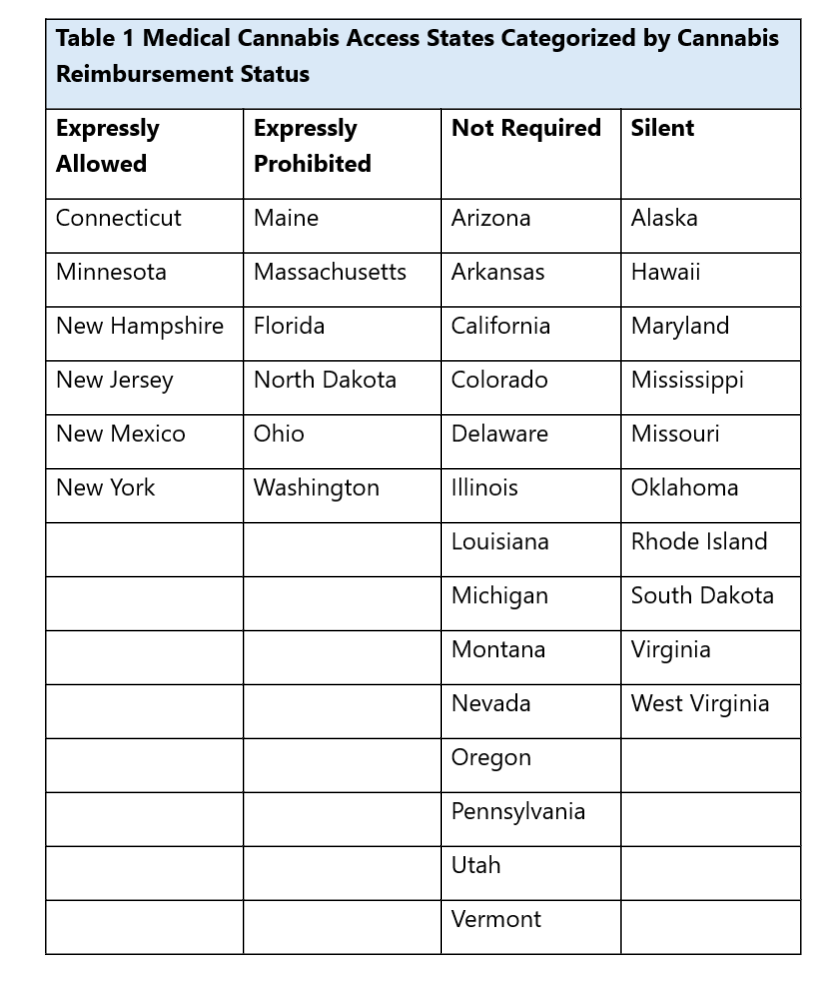
Of the six states that allow cannabis WCI reimbursement, four states (New Hampshire, New Jersey, New Mexico, and New York) do so based on a state court decision. Connecticut allows cannabis WCI reimbursement based on a state workers' compensation administrative panel decision, and Minnesota allows cannabis WCI reimbursement based on a state general administrative rule.
However, reimbursement is not automatic. WCI reimbursement is a medical benefit that is based on a worker's approved participation in, and conformance with, the state's administrative rules regarding medical cannabis access. Several factors are involved in obtaining cannabis WCI reimbursement to treat a work-related health condition. The article provides a discussion of each of the following factors.
- Workers' compensation insurance claim
- Diagnosis of a qualifying medical condition
- Evidence supporting state's list of qualifying medical conditions
- Patient/claimant registration in state's medical cannabis program
- Reasonable and necessary medical care
- Cannabis as medical treatment of last resort
In the discussion of cannabis as a treatment of last resort, the article notes that debilitating chronic pain—a condition common to many workers' compensation cases where cannabis treatment is at issue—requires medical evidence that a combination of non-cannabis treatments like surgery, physical therapy, cognitive and behavioral therapy, and prescription pain medications were tried but were shown to have failed in alleviating the worker's pain. Providing pain management that spares the injured worker the dangers of opioid addiction or overdose has become a key issue in workers' compensation medical care.[4]
The article provides details on each state's legal position and rational. Of the six states that expressly prohibit cannabis WCI reimbursement:
- State courts have determined that cannabis is not reimbursable because federal law preempts state medical cannabis access in Massachusetts and Maine.
- State legislation was enacted expressly to prohibit WCI reimbursement of medical cannabis in Florida and North Dakota.
- An administrative rule governing workers' compensation adopted before the state's medical cannabis access law prohibits WCI reimbursement of medical cannabis in Ohio and Washington because cannabis is not a drug approved by the FDA.
The article also provides a discussion of the factors involved in reimbursement, the medical requirements involving cannabis reimbursement, and a comparison to how selected Canadian provinces and territories administer reimbursement under Canada's new national cannabis legalization law.
Moving Forward
Cannabis treatment for work-related health conditions that are unresponsive to conventional medical treatments may increase as more workers petition state courts and administrative agencies for cannabis WCI reimbursement. Descheduling of cannabis on the U.S. federal level would likely accelerate the use of cannabis where it is determined to be a reasonable and necessary treatment for difficult-to-manage work-related health conditions. Anticipating the future trends in the United States and internationally, cannabis use in workers' compensation is an emerging occupational health and safety issue that deserves research attention.
The following research questions would help inform the issue:
(1) are there any demographic or health condition differences between workers who are able to obtain cannabis WCI reimbursement compared to workers who cannot obtain cannabis WCI reimbursement?
(2) will cannabis-reimbursed workers differ in their rehabilitation outcomes, returning to productive work faster compared to non-reimbursed workers?
(3) how will cannabis WCI reimbursement impact opioid overdoses and the risk of developing an opioid use disorder?
(4) will workers' compensation insurers that offer cannabis reimbursement experience
differences in claim severity?
(5) will reimbursed workers have different permanent disability outcomes?
(6) how will increased use of cannabis in WCI systems impact workplace safety and health and future incidence of work-related injuries and illnesses? and
(7) what are the most effective physician and insurer practices for treating a work-related health condition with cannabis?
The NIOSH Center for Workers' Compensation Studies uses workers' compensation data and systems to improve workplace safety and health. Learn more on their website.
Author Information
John Howard, MD, is the Director of the National Institute for Occupational Safety and Health.
Steven J. Wurzelbacher, PhD, is Director of the NIOSH Center for Workers' Compensation Studies in the NIOSH Division of Field Studies and Engineering.
Jamie Osborne, MPH, CHES® is a Public Health Analyst with the NIOSH Office of the Director.
- National Conference of State Legislatures. State Medical Marijuana Laws. May 17, 2021. Accessed September 11, 2021. https://www.ncsl.org/research/health/state-medical-marijuana-laws.aspx
- List of qualifying health conditions for medical marijuana for each state. Medical Marijuana Blog.com. October 26, 2017. Accessed September 11, 2021. https://www.medicalmarijuanablog.com/benefits-category/list-qualifying-health-conditions-medicalmarijuana-state.html
- Howard J, Wurzelbacher S, Osborne J, Wolf J, Ruser J, Chadarevian R. Review of cannabis reimbursement by workers' compensation insurance in the U.S. and Canada. Am J Ind Med. 2021;1-13. https://doi.org/10.1002/ajim.23294
- Ben-Shalom Y, McIntyre M, Pu J, Shenk M, Zhu W, & Shaw W. Workers' compensation and the opioid epidemic—state of the field in opioid prescription management. Report submitted to the U.S. Department of Labor by Mathematica. August 2020. Accessed September 11, 2021. https://www.dol.gov/sites/dolgov/files/OASP/evaluation/pdf/