



About
- Notice of Funding Opportunity (NOFO) CDC-RFA-DD-26-0025 addresses identified resource needs and opportunities for people with autism or fragile X syndrome (FXS) across the lifespan.
- The ultimate goal for this work is improving long-term outcomes for people with autism or FXS across the lifespan.
- Frequently asked questions (FAQ) on the NOFO can be found below.
NOFO purpose
On May 15, 2026, the Centers for Disease Control and Prevention (CDC)'s National Center on Birth Defects and Developmental Disabilities (NCBDDD) released funding opportunity CDC-RFA-DD-26-0025: Understanding and Promoting Resources and Opportunities for People with Autism and Fragile X and their Families Across the Lifespan.
The goal of this funding opportunity is to gather unique information to better understand the resources and opportunities needed to reduce morbidity, mortality, and improve other long-term outcomes for people with autism or fragile X syndrome (FXS) across the lifespan.
There are three components included in this NOFO:
- Component A: Survey to Promote Resources and Opportunities for aUtistic Teens and young adults (SPROUT) surveillance project
- Component B: Focus on Advancing Support and Transition with the Fragile X Online Registry With Accessible Research Database (FAST FORWARD) surveillance project
- Component C: Creating resources, support, and strengthening capacity for people with FXS
More information
Understanding and Promoting Resources and Opportunities for People with Autism and Fragile X and their Families Across the Lifespan
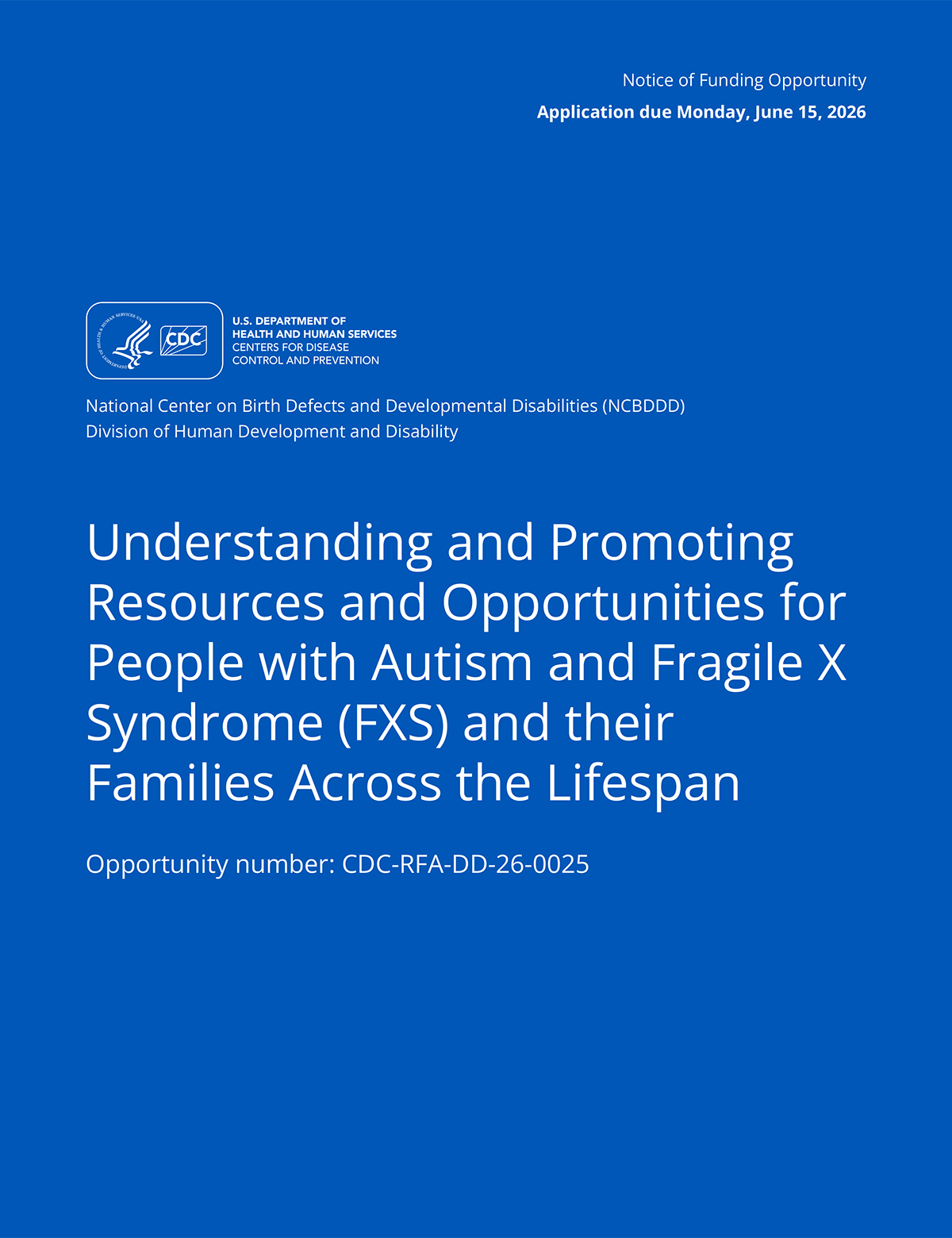
For more information on this funding opportunity, visit https://simpler.grants.gov and search for: CDC-RFA-DD-26-0025
Application DUE DATE: June 15, 2026, at 11:59 p.m. ET
Informational slides
![[thumbnail] (hidden)](/ncbddd/media/images/2026/06/CDC-RFA-DD-26-0025-Comp-A-Info-May-2026-thumb.png)
![[thumbnail] (hidden)](/ncbddd/media/images/2026/06/CDC-RFA-DD-26-0025-Comp-B-C-Info-May-2026-thumb.png)
Information session audio recordings
Listen to audio recordings of the informational sessions presented on May 27, 2026. Transcripts are available for each recording.
Frequently asked questions
Find answers to common questions
Application information
Q1. The NOFO states only one application per organization Unique Entity Identifier (UEI), but also says organizations may apply for one or more components. Can an organization submit a single proposal covering multiple components?
Yes. An organization may apply for one or more components if it meets each component's eligibility requirements. A single proposal may cover all three components.
Q2. Do all uploaded Resumes/CVs need to be the NIH-certified type, or only those for the PI and Co-Investigators? Should PI/Co-Investigator CVs be included in the attachment or handled elsewhere in the system?
There is no specific guidance in the NOFO regarding the format for CVs/resume. The NOFO states that CVs/resumes should be provided as attachments (PDF files) for proposed NOFO-funded personnel. Please see pages 46, 47, and 49 of the NOFO.
Q3. Is landscape page layout acceptable, or must the application be portrait only?
There is no specific guidance for the page orientation in the NOFO. Portrait layout typically allows for easier readability and is preferred.
Q4. Is the 20-page narrative limit inclusive of references?
Yes. If additional space is needed, references may be included as an attachment.
Q5. Are attachments limited to those specified in the NOFO?
Please refer to the NOFO for which attachments are required.
Q6. What should be included in the work plan table that links to the outcomes section?
Please refer to the timelines in Appendix A, B, and C (required performance measures for each component) in lieu of the outcomes section.
Q7. What is the difference between the "work plan" and "evaluation" sections? Must the work plan include activities beyond those in the NOFO?
Applicants must provide a separate work plan and evaluation and performance measurement plan. The work plan connects your performance outcomes, strategies, and activities, and measures. Please refer to the timelines in Appendix A, B, and C (required performance measures for each component). The evaluation and performance measurement plan includes the elements listed on page 42 of NOFO.
Q8. Since SPROUT (Component A) is not "research", do we need the Human Subjects table or should we omit that?
Since the table was not specifically requested in the NOFO, it is not required. This project is considered non-research.
Budget
Q9. Can all sites request $650,000 per budget year for Component A, with amounts adjusted after review?
Funding will be based on the number of eligible participants and SEED phases per site. Applicants may request the full amount, but the awarded amount may differ and could be adjusted through post-award budget discussions.
Q10. Is the $1 million per year / $5 million total for Component B in direct costs only, or does it include indirect costs?
The expected average award per budget period per Component B site is $333,333, inclusive of both direct and indirect costs. The $1 million per year amount represents the total NOFO funding for three Component B awards.
Q11. What format should the application budget categories follow?
Please use the format specified in the NOFO (Budget Narrative, page 67).
Q12. One clarifying point, there is not a specific max dollars gap for a Component B application, is there? It says expected to fund 3 Comp B sites, on average at 333,333 per year. But that is not a specific per site application cap, correct? Meaning, if I have a Year 2 or Year 3 budget of 339,000 my grant is not going to be thrown out for being over a required cap.
Since there is no ceiling listed (either by component or total award), all amounts are estimates and proposals will not be considered non-responsive based on their budget relative to these estimates.
IRB
Q13. What does it mean that funding cannot be used for "research"? Can sites analyze and publish data from this NOFO?
CDC has determined that SPROUT (Component A) and FAST FORWARD (Component B) are considered public health surveillance rather than research because they are monitoring outcomes in defined populations. Given this determination, the activities funded through this NOFO are not considered by CDC to be research. Awardee institutions may make their own determination as to whether these activities are considered research.
As described in the NOFO, awardees of Components A and B are expected to work individually or collectively to analyze and publish data. This activity would fall under Strategy 2: Translate data into high quality public health products.
Consistent with the Public Access to CDC Funded Publication Policy, all-peer reviewed publications funded by CDC must be made available to the public for free and full use with no embargo period regardless of the number of CDC-affiliated authors.
Q14. Will there be a single central IRB, or should each site plan to use its local IRB? Is there an associated cost?
Since CDC considers this project as "non research," CDC IRB approval will not be required. Each site should plan to use its local IRB to make its own research determination. CDC will work with each recipient as needed regarding their institution's research determination.
Q15. Are expenses associated with local IRB allowable in the budget?
If your local IRB determines that this project is "research" and there is an expense associated with IRB reviews, some IRB-related expenses may be allowable but specific expenses will be discussed with selected awardees.
Data Management
Q16. Where will REDCap be created and housed? Will sites have input into database contents?
CDC is developing the REDCap database based on surveys already submitted to OMB. Each site will host REDCap locally, with CDC support. There may be an opportunity for awardees to help refine the database after the project is awarded. The goal is to streamline questions and substantially reduce participant burden.
Q17. What data management responsibilities are expected of Component A and B sites beyond uploading files to CDC?
Staffing for epidemiologic and data management support is anticipated. Sites are expected to clean data using CDC-developed R code before transmitting standardized deidentified data to CDC using an established schedule and process. Sites are expected to maintain the most current version of the REDCap database. See pages 46 and 48 of the NOFO for full details.
Q18. Will the CDC-provided REDCap system be user-friendly, intended for direct participants interface, or is it designed for staff use? Do sites need to budget for design costs to make it public-facing/participant-friendly?
CDC is designing REDCap projects that will have the Component A and B surveys programmed and will allow sites to email a survey link directly to participants. Participants and caregivers will be able to enter responses to the survey using a mobile-friendly format to facilitate participant access and ease of completion. Survey data will populate directly into the local instance of the REDCap database hosted at each site. Component A and B surveys are currently under OMB review.
Q19. Will CDC provide R scripts for local data cleaning?
Yes. CDC is transitioning to R only. SAS support will not be provided.
Component A Programmatic Information
Q20. Are all former SEED participants/population groups eligible to participate in SPROUT?
Former SEED participants (ASD, DD, POP, and indeterminate status) who have consented to future contact, who did not decline future contact (did not attend a clinic visit thus did not answer the question about future contact), or who did not withdraw from the study may be recruited to participate.
Q21. Will sites attempt to recruit all eligible participants, even if the participant did not enroll in one or both follow-up surveys?
Yes. All participants who agreed to be contacted for future studies and who have not subsequently requested not to be contacted should be contacted for the opportunity to participate, even if they previously declined to participate in SEED Teen or SEED Follow-up.
Q22. If a caregiver does not participate in SPROUT, is their SEED child still eligible?
Yes. If the child is under age 18, the caregiver can give permission for the SEED site to contact the minor child. If the young adult is 18 years or older and can be reached, they may participate without caregiver participation or permission.
Q23. Will participants younger than 18 be asked to complete surveys?
There is no minimum age requirement. Any participant who can self-report may complete the survey.
Q24. Does the remote survey component require participants to be from original SEED catchment areas?
No. Catchment area residence is not an eligibility requirement for the remote survey.
Q25. Are the stated response rates a percentage of total participants or of each participation level (e.g., % contacted, % enrolled, % completed)?
The stated response rates are based on a percentage of the total eligible population.
Q26. Do participants have to complete the wave 1 survey in order to participate in the wave 2 survey?
No, participation in wave 2 is not contingent on completion of the wave 1 survey.
Q27. Are there copyrighted instruments that need to be budgeted for?
Copyrighted instruments do not need to be included in the budget.
Q28. What is the difference between a "data brief" and a "public health product"?
Data briefs are all-site analyses of specific topics determined by CDC (e.g., MMWR-style publications for SPROUT). Site-specific briefs present site-level data on those same topics or topics discussed with and approved by CDC. Data briefs are intended to allow timely data sharing without waiting until the end of the grant period. Site-specific data briefs are intended to encourage sites to share data back to their communities.
Public health products are meant to be a second route of data dissemination. Because the public consumes health information in many ways, the public health products are meant to support alternative or creative ways to disseminate information about SEED. They may be peer-reviewed publications or other, non-peer reviewed products with public health impact. Examples include but are not limited to infographics, ASL videos, easy-to-read summaries, webinar, targeted social media posts, and provider brochures.
Component B Programmatic Information
Q29. Can CDC provide feedback on whether a specific plan is acceptable as consistent with the structure proposed by the NOFO?
Due to the competitive nature of the NOFO, CDC cannot discuss application strategies with potential applicants. All applicants should thoroughly review the NOFO and develop applications according to the requirements specified in the NOFO.
Q30. Can a Component B site subcontract with other clinics for data collection? Can two clinics combine patient counts to meet the 200+ patient threshold?
There are no restrictions on subcontracts for any component, as long as the primary applicant meets all eligibility criteria. All clinics responsible for recruiting FXS participants must meet the eligibility criteria on page 13 of the NOFO.
Q31. Will clinical data from site records be entered into REDCap manually or via EMR extraction?
Either approach is acceptable. The volume of clinical data is not large, and EMR extraction is not prohibited.
Q32. Will FAST FORWARD continue longitudinal data collection from prior projects?
Previous participation in FORWARD or FORWARD-MARCH is not required either for a clinic to participate or for participants to be eligible for the study. Longitudinal data collection is not the focus of FAST FORWARD. Prior FORWARD or FORWARD-MARCH participants may be included in FAST FORWARD if they meet eligibility criteria. Longitudinal analyses linking current data to prior FORWARD data are not precluded.
Q33. What data can be used for Component B Strategy 2 public health products?
It is not anticipated that FAST FORWARD data will be available before the end of the data collection period. Required public health products may utilize data from previous CDC-sponsored fragile X data collections. External data from reliable sources may also be used to develop public health products.
Q34. How many public health products are required from Component B sites?
At least one public health product per site (all-site or single site) is required over the full grant period.
Component C Programmatic Information
Q35. Can Component C awardees play a role at Component B sites if they were involved in prior FORWARD projects?
The awards and funding streams are separate, but there is no explicit prohibition on Component C awardees collaborating with Component B sites. Funds from Component C are not to be used to cover Component B activities.
Q36. Does the required partnership with organizations "providing support" include medical, psychological, and other clinical organizations?
The NOFO does not specify that level of detail. The primary goal is to disseminate information to families, communities, and clinicians. Applicants should describe partnerships that support this dissemination goal.
This page was last updated on this date. Updates may include minor edits, image changes, or other modifications to page content.
The information on this page was last reviewed by subject matter experts to ensure accuracy.