Key points
- Field cage trials evaluate effectiveness of insecticide products in real-world conditions.
- Mosquito control programs should pair laboratory assays with field cage trials.

About field cage trials
Field cage trials evaluate whether formulated products and equipment deliver lethal doses in real-world applications. In contrast, laboratory assays like CDC’s bottle bioassay or topical applications measure a mosquito population’s level of resistance.
Field cage trials allow mosquito control programs to assess performance and account for influential factors, such as:
- Specific sprayer settings
- Local environmental conditions
- Targeted mosquito populations
- Chosen insecticide and application rates
Although these trials simulate real-world applications, they are resource-, time-, and space-intensive. Additionally, other ingredients in formulated products can mask resistance to the active ingredient. Mosquito control programs should pair laboratory assays with field cage trials for the most complete picture of resistance and efficacy.
How field cage trials work
For a typical field cage trial:
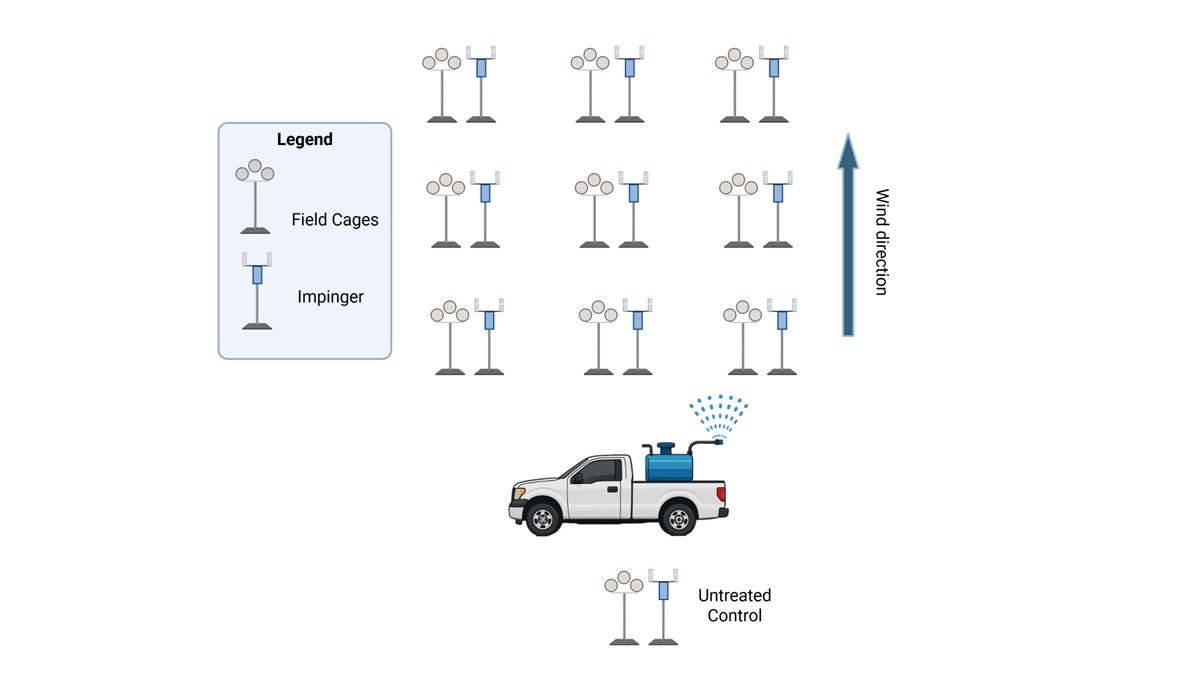
- Place mosquito cages in a 3×3 grid at increasing distances from the spray line, usually 100, 200, and 300 feet away.
- Drive a spray truck parallel to the rows of cages while applying the insecticide under normal operational conditions.
- After exposure, collect mosquitoes and hold for up to 48 hours to monitor mortality.