



Key points
- Japanese encephalitis occurs in Asia and parts of the western Pacific.
- It usually occurs in rural or agricultural areas.
Areas at risk for Japanese encephalitis
Travel alerts
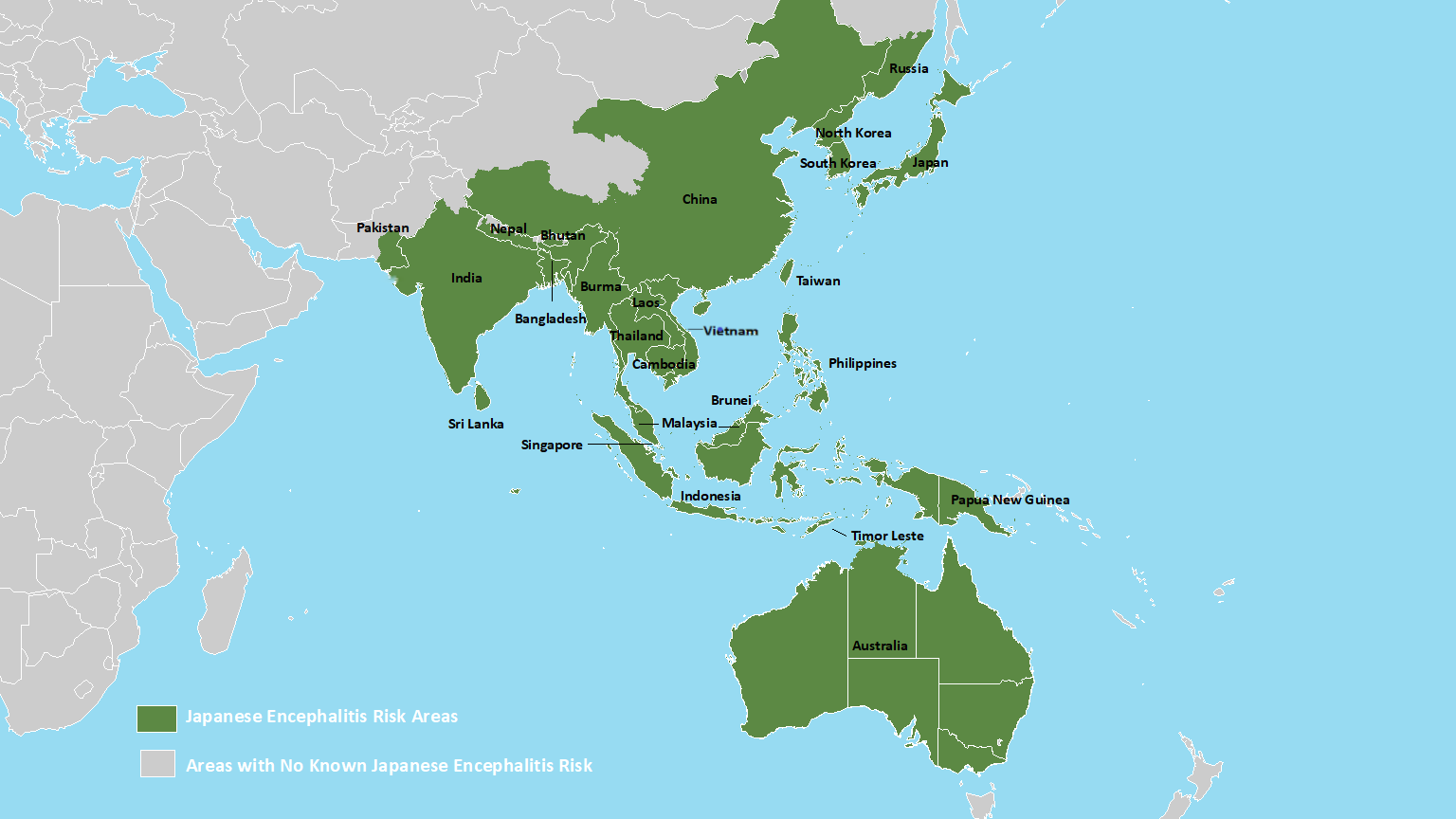
Areas at risk and transmission season, by country1,2,3
| Country | Areas at risk | Transmission season | Comments |
|---|---|---|---|
| Australia | Outer Torres Strait Islands, Tiwi Islands, and widespread parts of mainland Australia | November–May | Most travelers are at very low risk as no cases have been reported from major urban areas or main tourist areas.
Vaccination is recommended for longer-term (e.g., one month or more) travel to key risk areas of Outer Torres Strait Islands and Murray Valley region of New South Wales, Victoria, and South Australia. |
| Bangladesh | Widespread | Year-round
Most cases reported June–November |
Disease incidence is greatest in northwest Bangladesh. |
| Bhutan | Presumed widespread in non-mountainous areas | Unknown | Risk is likely greatest in southern districts that share similar ecologic conditions with bordering JE-endemic states of India. |
| Brunei Darussalam | Presumed widespread | Unknown | Limited data are available, but an outbreak was reported in 2013.
Proximity of Brunei Darussalam to Sarawak, Malaysia, suggests ongoing transmission is likely in some areas. |
| Burma (Myanmar) | Widespread | Year-round
Most cases reported May–September |
|
| Cambodia | Widespread | Year-round
Peak season May–October |
|
| China | All provinces except Qinghai | Southern China in April–October and in northern China in May–September | Vaccination is not routinely recommended for travelers to major cities or Hong Kong. |
| India | Andhra Pradesh, Arunachal Pradesh, Assam, Bihar, Chhattisgarh, Goa, Haryana, Himachal Pradesh, Jammu and Kashmir, Jharkhand, Karnataka, Kerala, Madhya Pradesh, Maharashtra, Manipur, Meghalaya, Nagaland, Odisha, Punjab, Tamil Nadu, Telangana, Tripura, Uttar Pradesh, Uttarakhand, West Bengal | Peak season May–November, especially in northern India; season can be extended or year-round in some areas, especially in southern India. | |
| Indonesia | Widespread | Year-round
Peak season varies by island. |
Cases have been reported from many islands, including Bali, Java, Kalimantan, Lombok, Papua, Sulawesi, Sumatra, West Timor. Transmission is likely on all islands. Several cases have been reported among travelers to Bali in recent years. |
| Japan | All islands | June–October | Rare sporadic cases have been reported from all islands except Hokkaido. Vaccine is not routinely recommended for travelers to major cities. |
| Laos | Widespread | Year-round
Peak season June–September |
|
| Malaysia | Widespread | Year-round
Peak season in Sarawak is October–December |
Much higher rates of disease have been reported from Sarawak than peninsular Malaysia. |
| Nepal | Southern lowlands (Terai), some hill and mountain districts | Peak season June–October | Highest rates of disease have been reported from southern lowlands (Terai). Vaccine is not routinely recommended for people trekking in high-elevation areas. |
| North Korea | Presumed widespread | Unknown
Proximity to South Korea suggests peak transmission May–November |
|
| Pakistan | Unknown | Unknown | Very limited data are available.
Previous case report and serosurvey data suggest transmission is possible at least in Sindh Province. |
| Papua New Guinea | Widespread | Presumed year-round | |
| Philippines | Widespread | Year-round
Peak season July–October |
|
| Russia | Primorsky Krai | June–September | No recent cases have been reported.
Vaccine is not routinely recommended. |
| Singapore | Presumed in very focal areas | Year-round | Vaccine is not routinely recommended. |
| South Korea | Widespread | May–November | |
| Sri Lanka | Widespread, except in mountainous areas | Year-round
Peak season November–February |
|
| Taiwan | Widespread | Peak season May–October | |
| Thailand | Widespread | Year-round
Peak season May–October, especially northern Thailand |
Highest rates of disease are reported from Chiang Mai Valley.
Several cases have been reported among travelers to resort and coastal areas of southern Thailand in recent years. |
| Timor-Leste | Presumed widespread | No data
Proximity to West Timor suggests year-round transmission |
|
| Vietnam | Widespread | Year-round
Peak season May–October, especially northern Vietnam |
1 Destination and transmission season information should be considered in association with travel duration and activities when making decisions on vaccination.
2 Data are based on published and unpublished reports. Risk assessments should be performed cautiously, because risk can vary within areas and from year to year, and surveillance data regarding human cases and Japanese encephalitis virus transmission are often incomplete. In some endemic areas, human cases among residents are limited because of vaccination or natural immunity among older people. However, because Japanese encephalitis virus is maintained in an enzootic cycle between animals and mosquitoes, susceptible visitors to these areas still may be at risk for infection.
3 Outbreaks previously occurred in the Western Pacific Islands of Guam (1947–1948) and Saipan (1990), but as they are no longer considered risk areas, they are not included in the table.
This page was last updated on this date. Updates may include minor edits, image changes, or other modifications to page content.
The information on this page was last reviewed by subject matter experts to ensure accuracy.