Key points
- In CDC's latest AMR Exchange, panelists discussed the roles of health departments and public health laboratories in detecting, responding to, and controlling outbreaks of antimicrobial-resistant bacteria and fungi.
- Panelists provided examples of infections prevented and lives saved in recent outbreaks due to health department and public health laboratory action, expertise, and infrastructure.
Roles of health departments and public health labs
In the tenth installment of CDC's AMR Exchange, presented in a series of short audio episodes, experts discussed the collaborative partnership of health department Healthcare-associated Infections and Antimicrobial Resistance (HAI/AR) Programs and CDC's Antimicrobial Resistance Laboratory Network (AR Lab Network) within and across states, territories, and cities to prevent the spread of antimicrobial resistance in the United States.
Episode 1: Collaborating to combat antimicrobial resistance
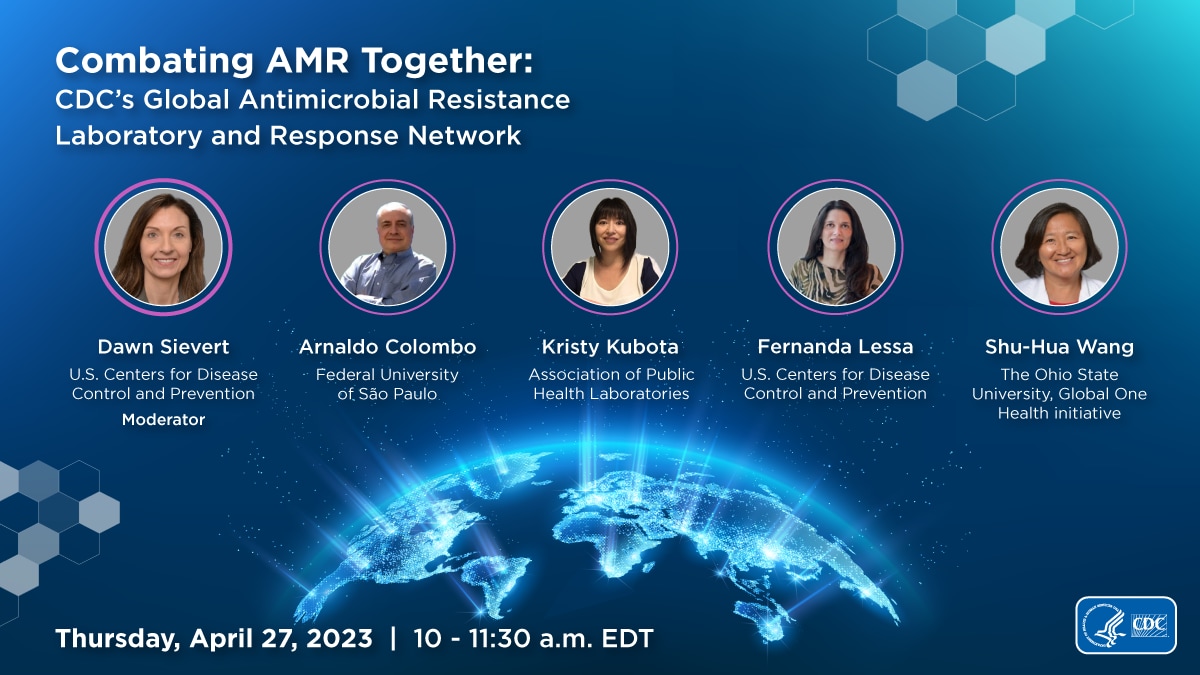
Dawn Sievert, senior science advisor for the Antimicrobial Resistance Coordination and Strategy Unit at CDC, served as moderator for the AMR Exchange. Dawn opened the series by providing an overview of CDC’s Antimicrobial Resistance Solutions Initiative, which has invested in building a strong national infrastructure to detect, respond, control, and prevent antimicrobial-resistant infections. CDC experts work hand-in-hand with HAI/AR Programs and the AR Lab Network to protect Americans from new and emerging infectious disease threats.
Episode 2: Combating antimicrobial resistance in Oklahoma
In the second episode of the series, Jessica Scheffe (microbiology general laboratory supervisor, Public Health Laboratory, Oklahoma State Department of Health), Brooke Harris (manager of microbiology and molecular, LabCorp Oklahoma), and Jeneene Kitz (director of infection control and prevention, Saint Francis Health System), explained how healthcare facilities and clinical laboratories play crucial roles in preventing outbreaks and addressing public health threats.
Jessica shared how collaboration between partners enables timely detection of antimicrobial-resistant bacteria and fungi. Working closely with partners helps generate actionable data which can be used to help implement appropriate infection prevention and control (IPC) practices to inform patient care. Brooke echoed Jessica, stating that communication and partnership across public health labs and clinical labs are critical. She explained how individual labs oftentimes do not see the results of other labs—what may be an unusual result in one lab could end up being a signal of an outbreak or emerging antimicrobial resistance. This could result in life or death for a patient if it is not properly communicated across partners. Jeneene expressed how it is the shared responsibility of infection preventionists, public health officials, healthcare providers, and other stakeholders to collaborate across the continuum of care and provide services that extend beyond the clinical side into the human side that removes fear and fosters a culture of safety for everyone.
Episode 3: Combating antimicrobial resistance in Connecticut
In the third episode of the series, Meghan Maloney (antimicrobial resistance coordinator, Connecticut State Department of Public Health) and Jafar H. Razeq (director, Connecticut State Public Health Laboratory) provided state-level insights, describing impacts an antimicrobial-resistant pathogen outbreak on residents of Connecticut. The Connecticut HAI/AR Program and public health laboratory, as part of the AR Lab Network, deliver clinically relevant services to combat new and emerging threats. Meghan and Jafar explained how this partnership between the health department and the state public health lab was critical to Connecticut triggering a nationwide investigation of an outbreak of extensively-drug resistant Pseudomonas aeruginosa in 2022. Collaboration between CDC, Connecticut, and other states identified the source of the outbreak that ultimately led to the recall of multiple contaminated products. The response to this outbreak also exemplifies the importance of state and federal-level collaboration to protect patients and prevent additional serious eye infections. Connecticut has a Multidisciplinary Technical Advisory Group that brings together experts (including infectious disease physicians, infectious disease pharmacists, infection preventionists, microbiology laboratory directors, and academic partners) to provide strategic decision making and address changes in antimicrobial resistance over time—further enforcing the importance of relationships between partners.
Episode 4: Informing and supporting local antimicrobial resistance action
In the fourth episode of the series, Maroya Spalding Walters, team lead of the Antimicrobial Resistance Team in the Prevention and Response Branch at CDC's Division of Healthcare Quality Promotion, discussed the sharp rise of carbapenemase-producing carbapenem-resistant Enterobacterales (CP-CRE) in the United States. CP-CRE has become increasingly difficult to treat over the years due to emergence in the U.S. of new strains with fewer treatments options. The spread of CP-CRE, which in the past was primarily found in acute care healthcare facilities, has expanded to pediatric centers, veterinary settings, and the community. CDC’s AR Lab Network helps play a crucial role by filling a gap in detecting CP-CRE and other emerging threats, which clinical labs may not have capacity to detect.
Maroya’s team, HAI/AR Program partners in health departments, and the AR Lab Network monitor trends in CP-CRE and use methods such as colonization screening, whole genome sequencing analysis, and infection control assessments to identify and respond to outbreaks. CDC provides response guidance and prevention strategies to health departments and healthcare facilities; helps lab partners with testing and implementation strategies; and provides health departments with updates on current epidemiology that can be used to address emerging public health threats. CDC continues to closely monitor how the epidemiology of CP-CRE is changing in the United States. Maroya emphasized the collective “we” and how all public health and clinical partners play a role in ensuring these infections are identified promptly to provide patients with timely care and treatment.
Episode 5: Supporting New York to combat antimicrobial resistance
In the fifth episode of the series, Belinda Ostrowsky, infectious disease physician and field medical officer at CDC, provided insights and lessons learned from on-the-ground work in New York to detect and respond to antimicrobial-resistant threats and how those approaches could be applied in other locations. Belinda, who is embedded in New York State Department of Health, highlighted trust as an invaluable mechanism when providing services to partners during an outbreak. During the COVID-19 pandemic, Belinda and team worked closely with healthcare facilities to enhance IPC practices (e.g., disinfecting healthcare equipment like ventilators) and strengthen their relationship by understanding the experiences of their partners and their patients. This same approach can be applied across healthcare facilities, labs, and other public health professional settings who each bring unique expertise to the table. Belinda highlighted that every state has a HAI/AR Program and is part of the AR Lab Network that works closely with CDC to address new and emerging public health threats.
Episode 6: Everyone play a role in combating antimicrobial resistance
In the sixth episode of this series, Dawn emphasized the all-hands-on-deck approach from Health Department HAI/AR programs, state public health lab partners in the AR Lab Network and CDC to combat new and emerging antimicrobial-resistant bacteria and fungi. The expert panelists in this AMR Exchange work every day to protect Americans from the threat of antimicrobial-resistant infections and other infectious diseases.