



What to know
Summary
A data story from the National Center for Health Statistics
Authors: Eleanor Fleming, PhD, DDS; Joseph Afful, MS; and Deanna Kruszon-Moran, MS
Get the data story
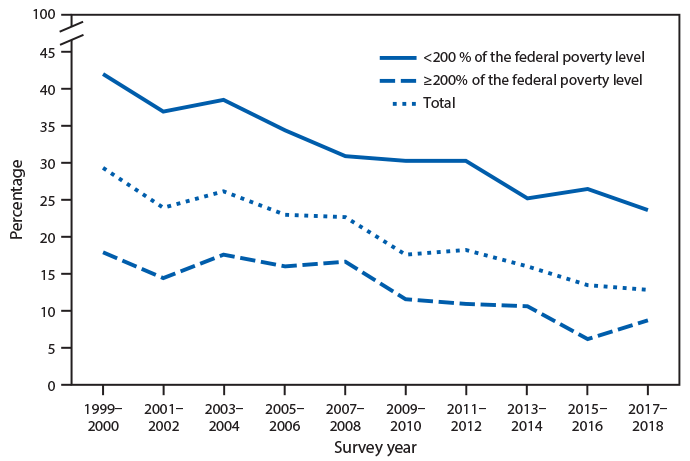
The age-adjusted prevalence of complete tooth loss among adults aged 65 years or older decreased from 29.3% during 1999–2000 to 12.6% during 2017–2018.
For the same period, the prevalence decreased from 42.1% to 23.5% for adults living at less than 200% of the federal poverty level and from 17.7% to 8.5% for adults living at more than 200% of the federal poverty level.
Throughout the period, the prevalence of complete tooth loss was higher among those living at less than 200% of the federal poverty level.
https://www.cdc.gov/mmwr/volumes/69/wr/mm6937a8.htm
Sources
Fleming E, Afful J, Griffin SO. Prevalence of tooth loss among older adults: United States, 2015–2018. NCHS data brief, no. 368. https://www.cdc.gov/nchs/products/databriefs/db368.htm.
National Center for Health Statistics, National Health and Nutrition Examination Survey, 2015–2018. https://www.cdc.gov/nchs/nhanes.htm.