



At a glance
CDC established an office in Nigeria in 2001. CDC works closely with the Ministry of Health and its partners to detect, prevent, and respond to infectious disease outbreaks at their source and neutralize public health threats. Improving global health core capacities in Nigeria makes America safer from infectious disease threats, averts major economic disruptions, and strengthens the U.S.-Nigeria strategic partnership.

Key accomplishments
- Helped the Nigerian government establish an automated biometric identification system within the National Data Repository to support HIV data deduplication efforts.
- Supported development of core laboratory diagnostic capacities to test for monkeypox, yellow fever, measles, Lassa fever, cholera, and cerebrospinal meningitis to quickly detect and respond to outbreaks.
- Supporting the Government of Nigeria to implement the integrated measles-rubella vaccination campaign that aims to vaccinate more than 100 million children.
- Developed a national Public Health Emergency Contingency Plan, and 16 plans for priority points of entry to aid preparedness operations and enhance response.
- In collaboration with the Nigeria Centre for Disease Control and Prevention, helped establish the Orange Network, a group of 41 tertiary health facilities that will serve as models for infection prevention and control (IPC) programs in the country.
Global health security
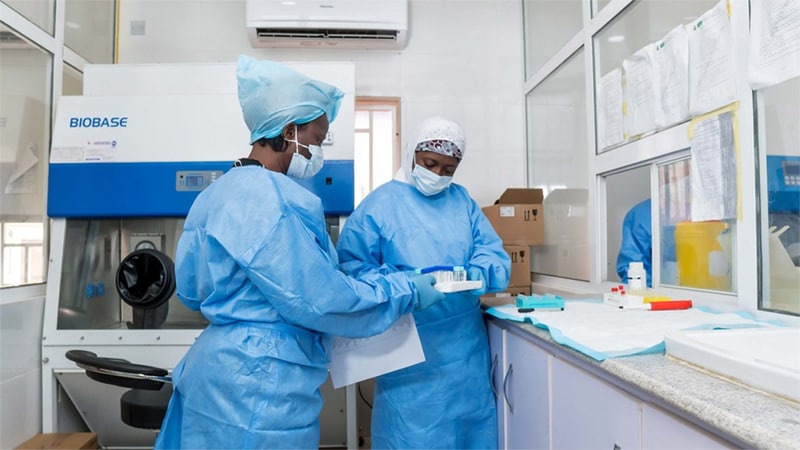
In 2019, Nigeria became a Global Health Security Agenda (GHSA) partner country. CDC works with the Government of Nigeria and partners to achieve GHSA goals by strengthening surveillance, laboratory, workforce development, and emergency response.
Surveillance
CDC helped Nigeria enhance its national surveillance systems in response to COVID-19, monkeypox, and acute febrile illnesses. CDC supported the strengthening of surveillance at points of entry to prevent disease spread across borders.
Laboratory
CDC helped develop core laboratory diagnostic capacity to test for monkeypox, yellow fever, measles, Lassa fever, cholera, and cerebrospinal meningitis. These efforts strengthened Nigeria’s ability to quickly detect and respond to outbreaks.
CDC also helped 14 labs achieve and maintain International Organization for Standardization, or ISO, accreditation, ensuring consistent delivery of accurate results to inform patient care and public health activities.
Workforce development
CDC has expanded workforce capacity by training 1,611 epidemiologists through the Field Epidemiology and Laboratory Training Program, 422 responders via the Public Health Emergency Management program, and 400 frontline specialists for immunization activities. The agency also supports the Lassa Fever Clinical Management Fellowship that has so far trained 31 fellows to treat patients and implement stronger infection prevention and control efforts, leading to a modest decrease in mortality at facilities where fellows work.
Emergency response
CDC provides comprehensive strategic direction and hands-on technical assistance to national and state emergency operations centers, enhancing coordination, decision-making, and rapid response during disease outbreaks. CDC collaborates with national and state governments and partners to support responses to outbreaks of monkeypox, Lassa fever, diphtheria, and many other diseases.
HIV and Tuberculosis (TB)
As a key implementer of the U.S. President's Emergency Plan for AIDS Relief (PEPFAR), CDC plays an essential role in the fight against HIV and TB. With unmatched scientific and technical knowledge and long-standing relationships with ministries of health, CDC is uniquely positioned to advance HIV, TB, and other global health security activities that keep Americans safe at home and abroad.
Through PEPFAR, CDC provides critical support to Nigeria's public health infrastructure, improving the country's ability to prevent and treat HIV and TB, minimizing their risk from entering the U.S. At the end of September 2025, CDC was providing life-saving treatment for 961,542 people living with HIV (PLHIV) and TB prevention to 60,116 PLHIV across 18 CDC-supported states.
Malaria
Nigeria has the most malaria cases in the world, with young children and pregnant women being the most affected groups. CDC has collaborated with national and international partners to support implementation of malaria prevention and control in Nigeria since 2011.
Immunization
CDC provides technical and programmatic expertise to eliminate or control vaccine-preventable diseases through immunizations. CDC works with international and local partners to strengthen immunization systems, introduce new vaccines, and expand routine vaccine delivery. CDC led development of the National Vaccine-Related Events Response Plan.
Infection prevention and control
CDC helped set up the national infection prevention and control program and training curriculum within the Nigeria Centre for Disease Control and Prevention. The agency supported the Surgical Site Infection Surveillance Pilot at tertiary health facilities and its current scale-up. In addition, CDC supported the development and pilot of the national IPC monitoring and evaluation tool to provide actionable data to help reduce illness and death related to healthcare associated infections.
Success story spotlight
CDC-Supported Surveillance System Helps Detect Dengue Outbreak
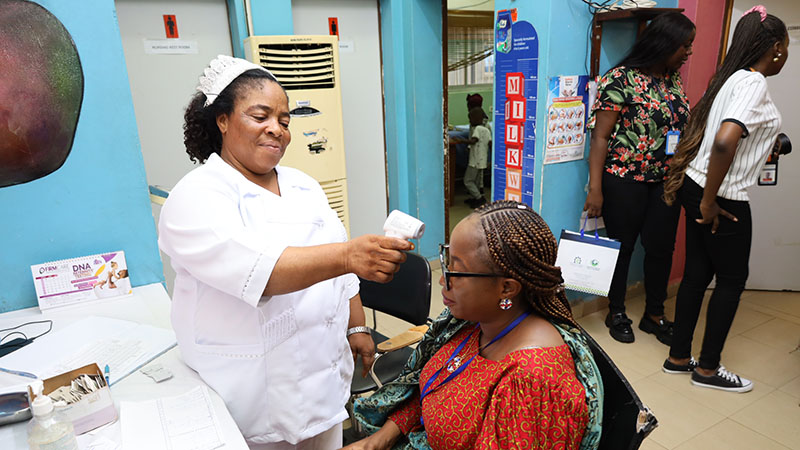
Since 2022, CDC has partnered with the Nigeria Centre for Disease Control and Prevention, state ministries of health, and implementing partners to establish acute febrile illness (AFI) surveillance in Nigeria. This system monitors and investigates cases of sudden-onset fever to detect outbreaks early and guide response efforts. Partnering with countries like Nigeria to enhance their disease surveillance systems is a crucial part of stopping health threats from reaching the United States.
A dengue fever outbreak was declared on July 4, 2025, in Edo State, one of Nigeria's six AFI sentinel sites selected for active disease surveillance, after a rising number of dengue fever cases was detected between January and June 2025.
CDC quickly strengthened case confirmation, improved data quality, and supported evidence-based decision-making. Global health security experts helped operate the Emergency Operations Center, deployed a rapid response team to support active case finding and surveillance, and provided technical support for line list analysis and situation report development. CDC also trained 10 laboratory staff to diagnose dengue using rapid diagnostic tests (RDTs) and supplied RDTs to two state-owned health facilities outside the AFI surveillance network, expanding testing capacity.
By the end of the outbreak on November 23, 2025, Edo State had recorded 522 suspected cases and 198 confirmed cases. No deaths were reported, highlighting the effectiveness of early detection and timely response.
CDC's support for early detection and response to dengue fever outbreaks in Nigeria helps reduce severe illness and prevent diseases from spreading. By strengthening integrated surveillance and laboratory systems and building resilient workforces, CDC is building sustainable, country-led capacity to detect, respond to, and contain public health threats at their source, helping to protect the lives of Americans at home and abroad.
![[thumbnail] (hidden)](/global-health/media/images/2025/11/Nigeria_thumbnail.jpg)