



At a glance
CDC has collaborated with partners in China for over 40 years and, in 2003, established a country office in Beijing to strengthen partnerships with the Government of China and public health agencies. Through collaborations with partners, CDC aims to increase local capacity to detect and respond to outbreaks, and enhance influenza virus detection, prevention, and control. CDC’s work in China protects the health of Americans and supports public health around the world.

Key accomplishments

- Collaborated on epidemiological investigations on disease burden and vaccine effectiveness to inform China’s measures to prevent influenza.
- Supported the response to outbreaks of human infection with avian influenza A (H7N9) virus.
- Trained public health workers through the China Field Epidemiology Training Program (CFETP). CFETP residents contributed to COVID-19 outbreak response activities.
- Identified priority zoonotic diseases in China, as an initial step to increase multisectoral collaboration in surveillance and outbreak response.
Global health security
CDC and the Chinese Center for Disease Control and Prevention, known as China CDC, collaborate on projects to address global public health priorities, particularly related to detecting, responding, and preventing infectious disease outbreaks.
Surveillance
Early detection of an emerging disease threat is critical to preventing outbreaks. Early detection can be particularly challenging in rural and hard-to-reach populations.
Examples of this work include:
• Strengthening One Health mechanisms to increase communication, collaboration, and coordination between the human, animal, and environmental health sectors for information sharing.
• Piloting community-based surveillance in high-risk areas to improve early identification of possible zoonotic disease transmission, among domestic and wild animals and local populations.
Emergency response
Since early in the COVID-19 pandemic, U.S. CDC and China CDC have regularly held virtual technical exchanges on a variety of public health topics, including COVID-19 vaccine effectiveness, program evaluation, monkeypox, and measles elimination.
More recently, CDC has worked closely with China CDC on strengthening multisectoral response to emerging and re-emerging disease outbreaks. This work focuses on:
- Introducing 7-1-7 bottleneck analysis, which helps countries identify barriers to detecting outbreaks within 7 days, to provincial and local Field Epidemiology Training Programs to better understand and address gaps in disease detection, notification, and outbreak response.
- Helping establish One Health rapid response teams that can be quickly activated for any type of public health emergency.
Influenza
Influenza viruses change often, and public health officials must remain vigilant to detect changes. For over 20 years, CDC has supported the China CDC to detect and track seasonal and novel influenza viruses. Monitoring influenza trends provides situational awareness to prepare for and respond to unusual trends or severe seasons. Early detection of novel influenza viruses can guide pandemic preparedness and planning. Determining disease burden and influenza vaccine effectiveness provides information to decision-makers on how to optimize medical countermeasures to control influenza. CDC works in close partnership with the China CDC, provincial and local CDCs, hospitals, and academic institutions.
Seasonal influenza preparedness
U.S. CDC supports the:
- Estimation of influenza disease burden, including societal and governmental cost of disease among people at risk for poor outcomes from influenza, to provide information to local decision makers about strategies to reduce influenza burden.
- Estimation of seasonal vaccination uptake and effectiveness among healthcare workers, children, and the elderly to inform influenza vaccination strategy development.
These efforts help guide national strategies for influenza control, including the use of vaccines and other medical countermeasures, which ultimately help reduce influenza-related hospitalizations and deaths.
Pandemic preparedness
U.S. CDC supports:
- Enhancing the multisectoral collaboration capacity for novel and pandemic influenza prevention and control so that partners can contain emerging health threats within their borders.
![[thumbnail] (hidden)](/global-health/media/images/2025/01/China_FS_2025_thumbnail.jpg)
Success story spotlight
Strengthening China's Field Epidemiology Training
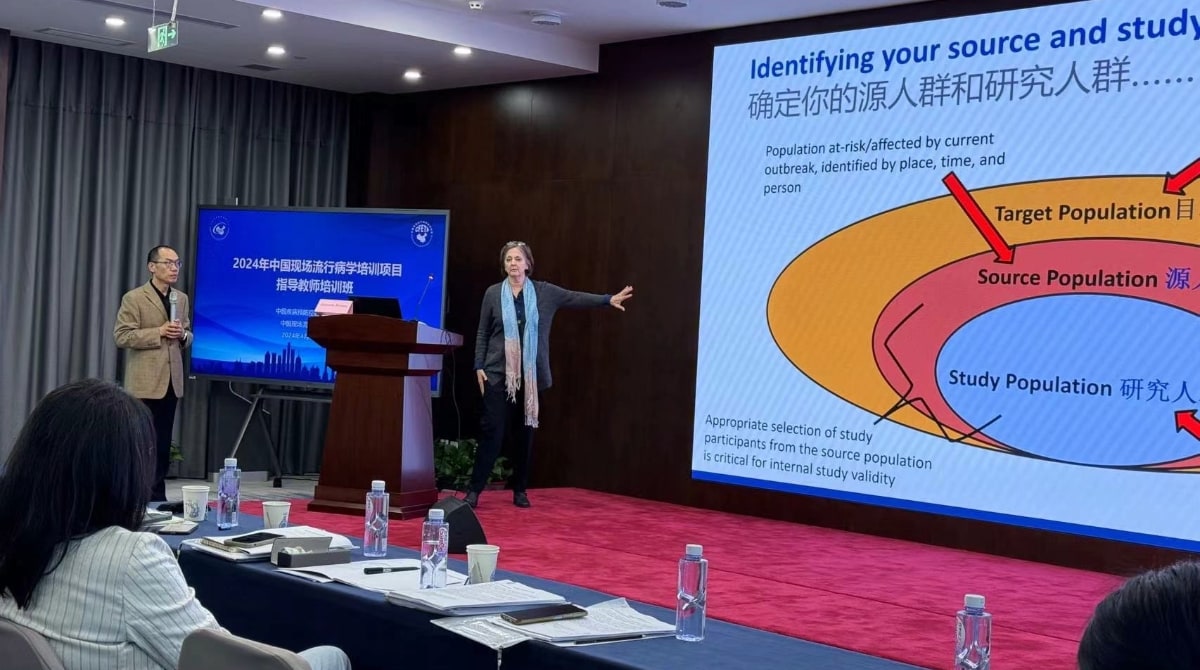
Disease transmission knows no borders. In the post-COVID-19 era, the U.S. CDC and China CDC have recognized the urgent need for collaboration to safeguard public health. The CDC China office has been working with U.S. China CDC to prioritize global health, and by strengthening local workforce capacity to detect and report disease clusters.
The U.S. CDC China office has collaborated with the Chinese Field Epidemiology Training Program (CFETP) in training epidemiologists who come across China. A key component of this collaboration is the annual mentor training workshop, an essential platform for mentors to stay updated on program issues and academic skills.
CFETP recently held a workshop in Beijing, attended by over 100 mentors from various provincial CDCs and the Hong Kong Department of Health. U.S. CDC China staff, including Country Director Dr. Will Schluter, participated.
The workshop emphasized the importance of on-the-job training, with sessions on adult learning theory and practical exercises in study design. Feedback from mentors highlighted the value of these sessions in improving the quality of field investigations and surveillance.
This joint workshop demonstrates the strong collaboration between the two agencies, addressing CDC China's technical priorities and providing a valuable opportunity to engage with mentors and understand field needs.