What to know
The Randomized Assessment of Influenza Vaccine Efficacy Network (RAIVEN) was a research collaboration between CDC, Westat, and multiple sites in the United States that conducted randomized trials to evaluate how well different influenza (flu) vaccines protected people 18-64 years old against flu. RAIVEN enrollment ended in December 2022. This page is for historical purposes and provides background about RAIVEN and how its findings support ongoing public health work.
RAIVEN trials
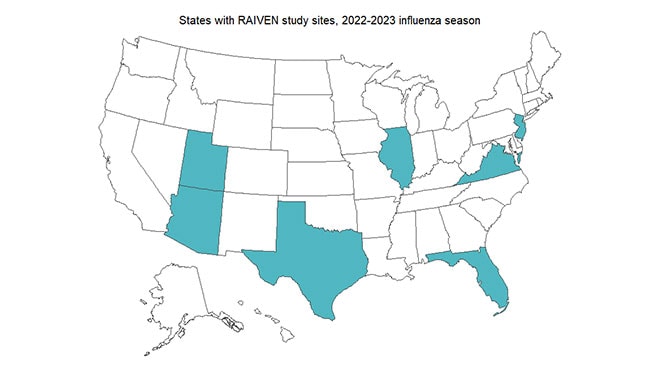
RAIVEN used innovative research methods to make flu clinical trials more accessible to people in U.S. communities. During fall 2022, RAIVEN launched a trial to compare how well the recombinant flu vaccine (RIV) worked compared with a standard dose egg-based flu vaccine (IIV) among people 18-64 years old (NCT05514002). Both vaccines are licensed for people in this age group in the United States. Participants in the trial were randomly assigned to receive one of the two vaccines as part of the study and were monitored for influenza virus infections throughout the flu season. The purpose of randomly assigning participants to receive a specific vaccine was to reduce differences between participants in the two vaccine groups to allow for a more valid comparison of flu illnesses and other outcomes between the two groups. The trial enrolled and followed participants during the 2022-2023 flu season.
Results
According to the publication that summarized this study, the trial enrolled 3,988 participants. This was 25% of the target sample size for effectiveness outcomes as the trial ended early due to funding constraints. The relative vaccine effectiveness (VE) of RIV compared with standard-dose IIV was 29% and was not statistically significant (95% Confidence Interval: -26% to 60%). Even so, the study found that RIV induced more robust antibody responses than standard-dose IIV against 2 of 4 flu vaccine viruses at one month and 3 of the 4 vaccine viruses six months after vaccination. This suggests possible improved and sustained immune protection from RIV compared to standard-dose IIV.
This study underscored key challenges in the design of randomized clinical trials to assess relative flu VE but also demonstrated the feasibility of using innovative approaches for trial enrollment.
Flu vaccine efficacy and effectiveness
Measuring flu vaccine efficacy and vaccine effectiveness (VE) is important to better understand how well flu vaccines work to protect against flu. Vaccine efficacy refers to how well vaccines protect people against infection in clinical trial research studies that randomly assign participants to receive specific vaccines. Vaccine effectiveness refers to how well vaccines protect people in real-world studies in which vaccines are not randomly assigned to people.
CDC measures VE each year to evaluate the benefits of flu vaccines in different age groups and against different clinical outcomes. The RAIVEN study complemented these VE estimates by comparing the efficacy of two types of licensed flu vaccines: standard-dose egg-based influenza vaccines and the recombinant influenza vaccine.