



Key points
- Build partnerships to ease coordination during emergencies, assess your school's needs, and develop an emergency operations plan (EOP).
- Have a variety of emergency supplies available. Conduct training and exercises to familiarize staff members and students with the EOP and teach them a variety of emergency preparedness and first aid skills.
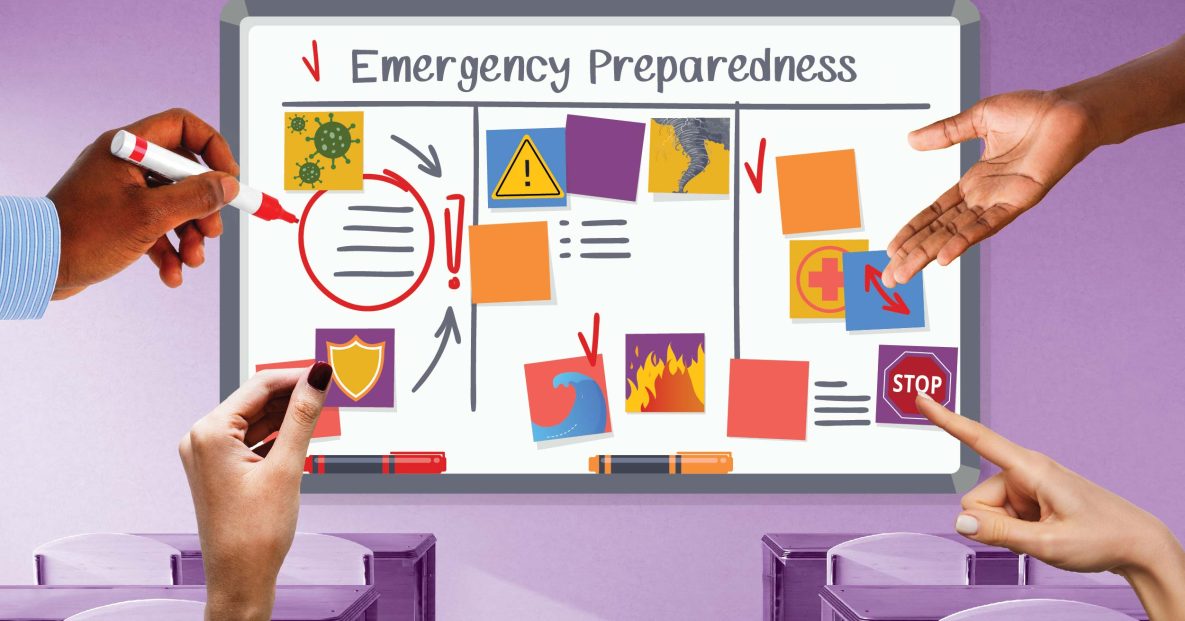
Build partnerships
To ease coordination during an emergency, school districts and schools can build and maintain relationships with the following organizations:
- Community organizations (healthcare facilities & providers)
- Public health officials (local health departments)
- Emergency management organizations (EMS, local law enforcement)
This can also include building interoperable data systems to share information about:
- Infectious disease impacts and outcomes
- Absenteeism rates
- School learning modality status
Schools can consider adding members to their school health advisory committees with expertise in certain subject areas. Examples of members with expertise to add include members with infection control or emergency response expertise.
Types of organizations and their role in school emergency preparedness
Local
Local emergency management agency personnel
Support:
- Resource management
- Emergency operations plan (EOP) development
- Exercises (as requested by the school or local education agency [LEA])
Local law enforcement, fire department, and other emergency services
- Enforce state laws
- Conduct building fire and safety inspections
- Partner with schools in planning, exercises, and response for emergencies occurring at schools
Local health departments
- Participate in EOP development and exercises (as requested by the LEA)
- Support case investigation and contact tracing of a local health problem or hazard
- Support or require case reporting from schools
Local health systems and healthcare providers
- Provide medical assistance and expertise before, during, and after an emergency
- Support EOP development for certain areas (e.g., infectious disease section)
- Participate in exercises as needed
State or territory
State/territorial education agencies
- Provide oversight, guidance, funding, and professional development to LEAs on preparedness policies and practices
State/territorial health departments
- Provide guidance to local health departments to support school preparedness activities
- Support case investigation and contract tracing
- Serve as liaison between the Centers for Disease Control and Prevention (CDC), local health departments, and LEAs for technical assistance as needed
Federally recognized tribal nations
Students from federally recognized tribal nations receive educational services through a variety of mechanisms. These educational services include tribe or Bureau of Indian Education (BIE) managed boarding schools or day schools. They also may attend public schools that can build and maintain partnerships with the local tribe(s).
Bureau of Indian Affairs (BIA)
- Fund, maintain, repair, and replace schools educating American Indian and Alaskan Native students
Bureau of Indian Education (BIE)
- Administer and oversee BIA-funded schools
- Develop preparedness trainings and guidance
- Provide support and technical assistance when requested
Tribally run or BIE-operated schools
- Develop, train, practice, and implement EOPs based on any requirements from the tribe
Indian Health Service (IHS)
- Provide a comprehensive health service delivery system for federally recognized American Indians and Alaska Natives
Local and tribal health departments (including tribal health not funded by IHS)
- Support EOP development and exercises (as requested by the school or BIE)
- Support case investigation and contact tracing of a local health problem or hazard
- Support or require case reporting from schools
United States federal agencies
Centers for Disease Control and Prevention
- Information on a variety of health problems and hazards
- Communication resources on emergency preparedness
- Technical assistance related to health problems or hazards
- Support for case investigation, contact tracing, and outbreak investigations of a health problem or hazard (when a locality/state or tribe requests assistance)
Department of Education
Through the Readiness and Emergency Management for Schools Technical Assistance Center (REMS TA Center) and federal school safety grants provides:
- Guidance
- Resources
- Tools
- Training
- Technical assistance
Department of Homeland Security
Provide information on Ready.gov about emergency preparedness.Through the Federal Emergency Management Agency (FEMA), provides:
- Preparedness resources
- Support during a declared emergency (when requested by a state or tribal government)
- Interactive tools to help government agencies and other organizations understand the National Preparedness System
Environmental Protection Agency
Provides resources about preparing for natural disasters, as well as information about specific chemicals.
Assess needs
Schools can work with their community to understand local circumstances that affect their:
- Staff members
- Students
- Families
This can include school-specific needs (such as those operating as boarding schools or serving unique populations) and students in:
- Juvenile detention centers
- Rehabilitation facilities
- Hospitals
- Group homes
It can also include individual or community-wide needs, as described in the table below.
Understanding these needs can help schools keep their staff members and students safe. Consideration of these community-wide and individual circumstances when communicating and when developing, testing, and putting into place the EOP is encouraged.
Examples of considerations include the following:
Culture
Schools can work to understand relevant cultural practices and beliefs that may affect how staff members, students, and families may react before, during, or after an emergency.
Language and literacy
Schools can provide resources in appropriate formats and languages before, during, and after an emergency so that all staff members, students, and families have access to information they can understand/read.
Location
Urban, suburban, and rural locations each have unique circumstances affecting transportation, access to healthcare, and other services.
Schools could work with partners to identify how their location may present challenges and opportunities.
School size
Schools can serve anywhere from a few to thousands of students. This can impact procedures, such as those for evacuating or sheltering in place.
Disabilities
Staff members and students with any type of disability (such as cognitive, mobility, vision, hearing, self-care, or independent living) may need additional support during or after an emergency. Schools could work with individuals and their families to identify these needs and plan accordingly.
For example, disabilities may affect an individual's ability to shelter in place or evacuate. They may also have complex medical needs to consider.
School closures can also impact access to disability services provided at or by the school.
More information about disabilities and emergency preparedness is available at: Emergency Preparedness and Disability Inclusion
Housing status
Staff and students with unstable housing, or who do not have consistent access to air conditioning or heat, may have additional needs during weather-related or other emergencies.
Family socioeconomic status
A family's socioeconomic status can affect their ability to practice certain prevention measures, respond during emergencies, and recover afterwards.
School socioeconomic status
A school's socioeconomic status can affect the wraparound services they are able to provide, along with their financial ability to prepare for and respond to emergencies.
Creating an action plan
Schools could use the following to develop an EOP:
- Partnerships
- Needs assessment
- Requirements from their school district or LEA
Make the EOP detailed. Address steps to take during and after various types of short- and long-duration emergencies. Schools can assign roles in the EOP to staff members. Schools can also ensure that plans account for the needs of children with access and functional needs.
Schools are encouraged to prepare for many different situations. Below is a list of example situations and how to prepare for and respond to them. Not all situations will apply to all schools. There are additional situations a school may face not listed here. However, this section highlights key principles to consider when preparing for a variety of emergencies.
Infectious disease outbreaks
For infectious diseases, schools can take actions every day to help prevent the spread of disease among students and staff members. The CDC guidance "Preventing the Spread of Infections in K-12 Schools" details considerations for preventing illness and planning for outbreaks. These include the following:
- Everyday actions for schools to control the spread of transmissible infections
- Considerations for when students or staff are sick
- Planning for outbreaks, epidemics, and pandemics
- Additional strategies used to minimize infectious disease spread when illness activity is elevated
- Considerations for maintaining school operational status
- Considerations for prioritizing additional prevention strategies
During an emergency, schools could use additional infection prevention measures relevant to the specific illness. Schools can work with local health officials, school nurses, and school-based health center staff to coordinate infection prevention, case management, contact tracing, and communication efforts.
Weather and natural disasters
Some weather-related emergencies require people to shelter in place, whereas others require people to evacuate.
Schools are encouraged to have enough supplies to shelter in place for at least 3 days. It may take time for emergency workers to reach and support the school. Examples of supplies include food, water, medication, first aid supplies, hygiene products, and various methods of communication.
In the case of an evacuation, schools can prepare for:
- How they will evacuate and account for each student and staff member.
- How they will evacuate people with disabilities.
- Where they will evacuate to.
- How to communicate with guardians for reunification after the emergency.
Example resources
Example resources include the following:
- The REMS TA Center provides a list of shelter-in-place and evacuation resources for schools
- Natural Disasters and Severe Weather
Chemical and radiation emergencies
A chemical or radiation emergency can occur:
1. When there's an accident (such as when transporting hazardous material, at a nuclear power plant, or at a chemical factory).
OR
2. Due to an intentional release.
Schools should consider being prepared and having the supplies mentioned above for sheltering in place or evacuating. Whether or not schools should transport students and staff or shelter in place depends on what authorities direct. They should consider having a way for exposed staff and students to:
- Shower
- Change
- Take other steps to decontaminate after exposure
If directed to shelter in place, schools may need to seal off the space by turning off:
- Fans
- Air conditioning units
- Furnaces
Schools may also need to close and lock all windows and doors, and limit food and beverage consumption to pre-packaged items. During a chemical emergency, schools can use duct tape and plastic sheeting to cover windows, doors, and vents. Alternatively, they can use towels or clothing in the vents and under the door. This seals the area from outside air while waiting on further direction from authorities.
Example resources
Example resources include the following:
- Radiological Emergency Preparedness and Response: Educational Facilities Preparedness and Legal Study
- What Should you do in a Chemical Emergency?
- Radiation Emergencies—What should I do?
Violence-related emergencies
Violence can occur at schools or in the surrounding community. Schools should plan for how they will work with law enforcement, emergency personnel, and media during an emergency. They could also consider how:
- To identify potential threats and prevent violence from occurring within their school.
- To respond to various forms of violence at the school.
- To reunite students with their families after an emergency.
Example resources
Example additional resources include the following:
Gather supplies and records
Schools are encouraged to have a variety of supplies available ahead of time in case of an emergency. These supplies will vary based on the emergencies a school may face.
Schools can maintain student records necessary during an emergency, such as:
- Daily attendance
- Room assignments
- Seating charts
- Parent/guardian contact information
These should also be accessible in case of evacuation.
Conduct Trainings
Training
It is important that staff members are familiar with their roles in the EOP. Schools can also communicate about relevant portions of the plan with parents and other guardians.
Schools can offer opportunities for students and staff to learn a variety of emergency preparedness and first aid skills, including:
- Infection prevention and control (IPC)
- CPR
- First aid for severe trauma response
The school district can support these efforts through raising money and providing or contracting out trainings. These trainings can help ensure rapid action during an emergency.
Practice the plan
Schools should consider regularly conducting exercises so they can practice using their EOP to respond to both short- and long-duration emergencies. When conducting exercises, they can partner with local emergency management personnel, first responders, health departments, and relevant organizations.
More information
- The REMS TA Center provides a list of resources for K-12 emergency exercises.
- For information about the participation of students in exercises, read the American Academy of Pediatrics policy statement: Participation of Children and Adolescents in Live Crisis Drills and Exercises.
During an emergency
- Once an emergency begins, schools should put their EOP into action.
- Once an emergency begins, schools should put their EOP into action.
- Putting the EOP into action ensures that they are working with partners to share and receive information.
- Schools are also encouraged to communicate with parents during this time.